Twitter (X): History, Features, and How to Use It in 2026
Key Takeaways
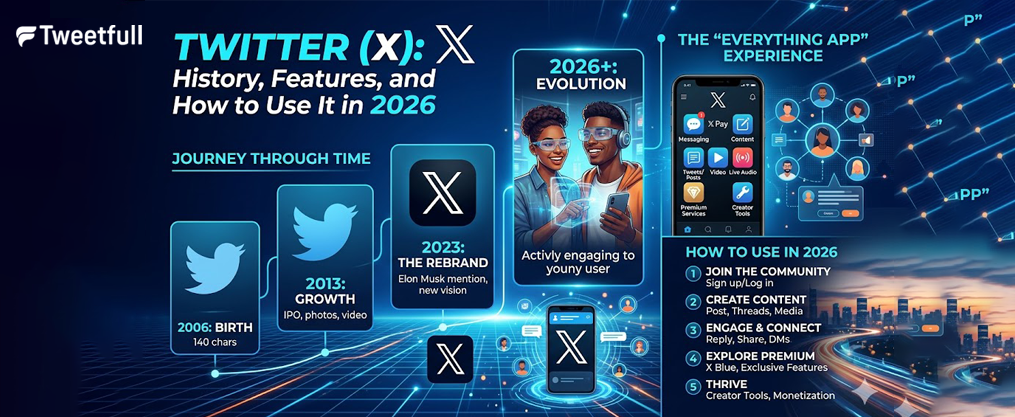
- Twitter launched in March 2006 as a 140-character microblogging experiment, went through an IPO in 2013, and was acquired by Elon Musk for $44 billion in October 2022 before rebranding to X in July 2023 and moving to x.com in May 2024.
- X combines real-time news, social networking, creator monetization, and emerging fintech through the X Money Account announced in 2025, positioning itself as an “everything app” with long-form posts, live audio and video, and ecommerce features.
- The platform remains one of the largest text-first social media platforms globally, though it faces increasing competition from apps like Meta’s Threads and decentralized alternatives like Bluesky, particularly on mobile. The introduction of a premium tier (Twitter Blue/X Premium) has impacted verification, enhanced features, and priority visibility for subscribers.
- Elon Musk’s acquisition triggered significant changes including mass layoffs, paid verification via X Premium tiers, and policy shifts that have sparked ongoing controversies around moderation, misinformation, and advertiser relationships. Users can now choose between an algorithmic feed, which personalizes content, and a chronological feed, which displays tweets in real-time order.
- Understanding the current landscape of features, subscription tiers, and safety tools is essential for anyone using X professionally or personally in 2026.
Introduction to Twitter / X
In 2026, X—formerly known as Twitter—stands as one of the most influential real-time communication platforms in the world. What began as a simple microblogging service built around 140-character status updates has evolved into a sprawling social media platform encompassing text posts, live video, audio conversations, creator monetization, and even financial services. Many people still refer to the platform as “Twitter” and call posts “tweets,” even though the official branding changed to X in July 2023 and the domain shifted to x.com in May 2024.
The key dates tell the story of transformation: Jack Dorsey sent the first tweet on March 21, 2006. The company went public in November 2013. Elon Musk’s acquisition closed on October 27, 2022 for approximately $44 billion, triggering a complete rebrand less than a year later. By 2025, X Corp was transferred to xAI, Musk’s artificial intelligence venture, further integrating the platform with his broader tech ambitions.
People use X today to consume breaking news, follow political conversations, track sports news, engage with pop culture, communicate as brands, and monetize content as creators. The platform positions itself as a trusted digital town square where conversations unfold in real time, actively shaping public dialogue on social issues, politics, and cultural topics—though that positioning comes with significant debate about moderation, misinformation, and who controls public discourse.
This article covers everything you need to understand about X in 2026: its history from SMS experiment to “everything app,” core features like posts and Spaces, business and monetization tools, safety and regulatory challenges, and practical tips for using the platform effectively.
History of Twitter and the Road to X
Twitter’s journey from a side project at a failing podcast company to a globally influential platform under Elon Musk’s ownership represents one of the most dramatic arcs in tech history. Early on, venture capital played a crucial role in fueling Twitter’s growth and enabling its rapid expansion. Understanding this trajectory helps explain why X works the way it does today and where it might be headed.
The platform emerged in early 2006, originally launched as Twttr, a name inspired by the short messaging service concept and the five-character length of American SMS short codes. It gained cultural relevance through real-time event coverage, went public in 2013, achieved its first profitable year in 2017, experimented with audio and subscription features through 2021, and then underwent radical transformation after Musk moved to acquire Twitter in 2022. Each phase shaped the product, culture, and controversies that define X today.
When Twitter went public in 2013, its IPO raised $1.8 billion, marking a significant milestone in its evolution as a major social media platform.
2006–2013: From “Twttr” Experiment to Public Company
Twitter originated during a brainstorming session at Odeo, a podcasting startup struggling after Apple integrated podcasts into iTunes. Jack Dorsey, then an NYU student and Odeo engineer, proposed a platform for sharing short status updates via SMS with small groups. The team initially called it “Twttr”—inspired by Flickr’s vowel-free naming style and constrained by the five-character limit for SMS short codes. The name “Twttr” was also inspired by the short messaging service concept and the five-character length of American SMS short codes.
Dorsey sent the first-ever tweet on March 21, 2006: “just setting up my twttr.” The service publicly launched on July 15, 2006, developed rapidly by Dorsey, Noah Glass (who pushed for the Twttr name), Biz Stone, and Evan Williams. After Obvious Corporation acquired Odeo’s assets including Twitter.com in October 2006, Twitter spun off as an independent company in April 2007. Early-stage venture capital played a crucial role in supporting Twitter’s development and scaling during this period.
The South by Southwest Interactive conference in March 2007 became Twitter’s breakthrough moment. Daily tweets surged from roughly 20,000 to 60,000, and the platform won the Web Award. Twitter quickly became essential for tech industry conversations, event coverage, and meme culture.
Key features arrived organically during this period:
- Hashtags emerged in 2007, invented by user Chris Messina
- @mentions and retweets formalized by 2008–2009
- Verified badges launched in 2009 for public figures and celebrities
- Trending Topics debuted in 2008 to surface what the world was discussing
The platform’s role in Iran’s Green Movement protests in June 2009 demonstrated its potential for political mobilization and earned Twitter a Webby Award for Breakout of the Year. By March 2012, Twitter had reached 140 million active users posting 340 million tweets daily.
The November 7, 2013 IPO on the NYSE under ticker TWTR marked Twitter’s transition from startup to public company, intensifying pressure for user growth and monetization that would shape the next decade.
2014–2021: Maturity, New Features, and Profitability
As a public company, Twitter expanded beyond short text with native photos (2011), video uploads, and live streaming partnerships with sports leagues and news networks beginning around 2016. These additions transformed Twitter into a multimedia platform and second-screen companion for television events.
Significant product changes during this era included:
Year | Change |
|---|---|
2010 | Dual-pane redesign overhaul |
2015 | Moments launch for curated event stories |
2017 | Character limit expansion from 140 to 280 |
2019 | Major web redesign |
2020 | Fleets launch (ephemeral stories) |
2021 | Twitter Spaces wide rollout |
2021 | Twitter Blue subscription debut |
The 2017 character expansion represented a philosophical shift, acknowledging that the original SMS-inspired constraint sometimes hindered expression. That same year, Twitter achieved its first full-year profitability after years of losses, showing the business could sustain itself. |
Twitter introduced Fleets in November 2020 as ephemeral stories disappearing after 24 hours—then shut them down by June 2021 after low adoption. More successful was Twitter Spaces, a live audio feature that launched in beta in late 2020 and rolled out widely in 2021, capitalizing on the Clubhouse audio trend.
Twitter Blue debuted in June 2021 as an optional subscription offering features like undo tweet and custom app icons. This marked Twitter’s first direct consumer subscription product, foreshadowing the premium tiers that would become central under Musk.
Throughout this era, Twitter struggled with harassment, bots (estimated at 5-15% of accounts in various studies), and misinformation. The platform formed a Trust & Safety Council in 2016 to address these issues, though critics questioned its effectiveness.
Since 2022: Musk Acquisition, Rebrand to X, and xAI Era
Elon Musk’s involvement began in April 2022 when he disclosed a 9.2% stake in Twitter. His $44 billion bid to acquire Twitter triggered months of legal battles after Musk attempted to back out, claiming bot prevalence exceeded disclosed levels—he alleged 20% of accounts were fake or spam. The deal closed on October 27, 2022, with Twitter immediately delisting from the NYSE on November 8.
The transformation was immediate and dramatic:
- Mass layoffs cut approximately 50% of Twitter’s 7,500 employees initially, with more following, including significant reductions in trust and safety teams
- Paid verification launched via a relaunched Twitter Blue in late 2022, tying the blue checkmark to subscription rather than identity verification—sparking impersonation chaos
- Account reinstatements brought back previously banned accounts including Donald Trump in November 2022
- Moderation relaxation changed enforcement priorities with a stated emphasis on free speech
Under Elon Musk’s ownership, X has faced significant controversy, including the release of the Twitter Files, the suspension of ten journalists’ accounts, and labeling media outlets as ‘state-affiliated’, which has sparked widespread criticism. In response to allegations it deemed unfair, X Corp. has pursued legal action against nonprofit organizations Media Matters and the Center for Countering Digital Hate, highlighting ongoing tensions regarding content moderation and misinformation. Since Musk’s acquisition, many organizations have reduced their presence and advertising on X due to concerns over misinformation and the platform’s reliability as a source of information, particularly regarding serious issues like politics and human rights.
The July 2023 rebrand replaced the iconic bird logo with a stylized X, signaling Musk’s vision for the platform as more than social media. The domain shifted to x.com in May 2024, completing the visual transformation.
X Premium tiers expanded significantly:
Tier | Key Features |
|---|---|
Basic | Verification badge, some features |
Premium | Fewer ads, post editing, longer video |
Premium+ | Ad-free in some sections, up to 25,000 character posts, enhanced creator revenue |
The 2025 announcement of X Money Account in partnership with Visa introduced peer-to-peer payments and banking features (initially without cryptocurrency), positioning X toward Musk’s stated “everything app” ambitions. That same year, X Corp was transferred to xAI, Musk’s AI venture, accelerating integration of Grok—an AI assistant powered by xAI—into feeds and search. |

Core Concepts: Tweets, Posts, and the X Timeline
The fundamental unit of X remains the post—what users historically called a “tweet.” While official terminology changed with the rebrand, both terms persist in everyday use. The platform has evolved from supporting only short posts to now allowing longer content, reflecting the broader shift in social media toward diverse content formats. Understanding how to create posts and navigate timelines is essential for any twitter user.
Posts default to a 280-character limit, expanded from the original 140 in November 2017. Premium subscribers can publish longer posts—up to 25,000 characters for Premium+ users—enabling essay-length content directly on the platform. Posts can include text, images, GIFs, videos, polls, and links (automatically shortened via t.co).
The basic interaction model includes:
- Posting original content
- Replying to create threaded conversations
- Reposting (formerly retweeting) to share someone else’s post with your followers
- Quoting to repost with your own commentary
- Liking to bookmark appreciation
- Bookmarking to save for later reading
Users can choose between two main timeline modes: the algorithmic “For You” feed, which curates content based on engagement signals, user preferences, and interests, and the chronological “Following” feed, which displays posts from accounts you follow in real time. The platform features a scrolling feed that includes both the curated algorithmic feed and the chronological following feed. Over the years, Twitter’s user interface has undergone several redesigns to improve navigation, layout, and overall engagement. Users can follow any public account without mutual agreement, as the platform operates on a subscription model. Ads and promoted tweets appear in both feeds, shaping user experience and driving platform revenue. Planning and scheduling x posts is important for maintaining consistency and building engagement on the platform.
Tweet Composition and Formats
Content on X spans multiple formats, each serving different purposes:
- Plain text remains the foundation—quick takes, observations, questions
- Images up to four in a carousel format
- Videos up to 140 seconds for free accounts, 2+ hours for Premium
- GIFs for reactions and humor
- Polls with up to four options
- Links with preview cards (though external links may receive reduced algorithmic reach)
- Long-form posts for Premium subscribers wanting to publish longer posts directly
The evolution from 140 to 280 characters in November 2017 acknowledged that SMS constraints no longer made sense. The 2023-2024 introduction of multi-thousand-character posts for Premium tiers further expanded possibilities, letting creators share entire articles without leaving the platform.
Hashtags (#topic) and @mentions (@username) connect posts into broader conversations and make content searchable. Hashtags group posts around themes—#WorldCup or #BreakingNews—while @mentions notify specific accounts and create direct engagement.
Richer media has become increasingly important. Vertical video, live broadcasts, and recorded Spaces clips now embed directly in posts, reflecting X’s push to compete with video-first platforms. A breaking news headline from a journalist, a sports clips showing a game-winning goal, or a gaming sessions highlight can all live natively on X. Grok, X’s AI assistant, can now explain videos by summarizing trending news, clarifying complex topics, and providing additional context for video content and posts to enhance user understanding.
Engagement: Replies, Reposts, and Quote Posts
Replies create public responses that appear in threaded conversation views beneath original posts. When you reply, your response shows in your timeline and the original poster’s mentions. Replies form the conversational heart of X, where debates happen and relationships build.
The “Repost” (formerly retweet) amplifies someone else’s post to your followers with a single tap. This simple mechanism drives viral distribution—a post seen by 1,000 people can reach millions through cascading reposts. Reposting signals endorsement, though the “RT ≠ endorsement” disclaimer once common has faded.
Quote posts combine reposting with commentary. Rather than silently sharing, you add your reaction, analysis, or critique above the original. Quote posts often perform well algorithmically because they add value beyond pure amplification—they contribute more context and generate their own engagement.
For brands and creators, strategic engagement matters:
Engagement through replies and quotes typically drives more algorithmic reach than broadcasting alone. The algorithm rewards conversation.
Likes, bookmarks, and profile clicks all count as engagement metrics influencing how X surfaces content. Watch time on videos, reply velocity (how quickly posts generate responses), and repost depth all factor into recommendations. Keeping your audience engaged with conversation, not just content, aligns with how the platform works.
Key Features of Twitter / X: Direct Messages and More
X is more than a simple feed, allowing users to communicate with friends and make connections by following each other’s feeds, which enhances engagement and interaction. The platform includes Lists for curated timelines, Twitter Spaces live audio conversations, Communities for topic-based groups, advanced search, and X Pro for power users, allowing users to customize their experience and interact in various ways. Understanding these features lets you extract value beyond the main timeline’s noise.
Some features from Twitter’s history—like Fleets—have been sunset, while others like Spaces continue evolving with monetization options. The feature set reflects X’s ambition to be an ultimate destination for real-time information, not just another social media app.
Trending Topics and Hashtags
X surfaces “Trending” content by country and city, calculated from the volume and velocity of posts containing shared phrases or hashtags. Users can discover these trending topics by typing relevant keywords, hashtags, or user handles into the search bar, which helps navigate to specific accounts, trending discussions, or explore what’s popular in real time. Introduced in 2008, trends became essential for real-time awareness—knowing instantly when live breaking news happens, when memes spread, or when crises unfold. Viral conversations often emerge from these trending topics, rapidly spreading across the platform and shaping online dialogue and engagement.
The trending algorithm factors in:
- Post volume mentioning a phrase
- Velocity of growth
- Geographic relevance
- Time decay
However, trend manipulation remains a documented problem. Bot networks push artificial trends, coordinated campaigns amplify conspiracy theories, and fake local trends have misled users. X occasionally intervenes manually to suppress objectionable trends—hate speech, explicit incitement, or harmful misinformation.
Treat trends as signals, not facts. Verify information before amplifying it, especially during elections, disasters, or viral scandals.
Relevant trending topics can expose your content to massive audiences if you contribute meaningfully to conversations. But joining trends purely for visibility without adding value often backfires, appearing opportunistic or spammy.
Using hashtags on X helps categorize posts and improve discoverability, making it easier for users to find content through the search bar and trending topics. However, using too many hashtags can negatively impact engagement and may even be penalized by the algorithm, so strategic use is recommended.
Lists and Curated Feeds
Lists allow you to build communities tailored to specific interests without cluttering your main Following feed. A List is a custom collection of accounts—public or private—that generates its own separate timeline.
Practical use cases include:
- Journalists tracking political beats or industry sources
- Investors monitoring market commentators and financial analysts
- Sports fans following team insiders and beat reporters
- Professionals keeping up with thought leaders in their field
Introduced in 2009, Lists remain one of X’s most powerful but underused tools. Instead of following hundreds of accounts and overwhelming your main feed, you can subscribe to curated Lists—or create your own—to explore diverse perspectives when you want focused content.
Subscribe to respected public Lists maintained by journalists or industry experts rather than trying to discover and follow every relevant account individually.
Lists help you cut through algorithmic noise and access chronological, topic-specific information on demand.
Spaces and Live Audio
Twitter Spaces launched widely in 2021 as live audio rooms where hosts hold real-time discussions with listeners and invited speakers. Anyone can start a Space, invite speakers, and host discussions on any topic—from post-game sports analysis to live game commentary, tech Q&As, or political town halls.
Key Spaces capabilities:
- Recording for later playback or repurposing as podcasts
- Ticketed Spaces for paid-entry events
- Speaker management including invitations and muting
- Live transcription in supported languages
- Listener reactions and emoji responses
Spaces became a popular audio feature for creators seeking direct audience connection. A live podcast format lets hosts share expertise while listeners submit questions in real time. Some creators use Ticketed Spaces for monetization, charging admission to exclusive conversations.
The feature serves breaking live news well—analysts discussing market moves, journalists debriefing after major events, or fans reacting to live events like game results or award shows. Spaces creates intimacy that text posts cannot match.

Multimedia: Images, Video, and Live Streams
X supports rich multimedia directly in posts:
Format | Limits |
|---|---|
Images | Up to 4 per post, carousel format |
GIFs | Embedded, looping |
Video | Up to 140 seconds (free), hours (Premium) |
Live streams | Native broadcasting |
The 2016-2018 era saw aggressive live streaming partnerships with sports leagues and news networks, making Twitter a second-screen companion for television. Today, creators and brands use live video for product launches, commentary, and real-time engagement, with content delivered instantly to users for maximum immediacy. |
Long-form and vertical video now receive emphasis, competing with TikTok and YouTube Shorts. Eligible creators meeting view and follower thresholds can monetize video through creator revenue sharing programs that pay out a portion of ad revenue.
Fleets—ephemeral stories launched in November 2020 and removed by June 2021—demonstrated X’s willingness to experiment and quickly pivot when features underperform. Not every multimedia experiment succeeds, but the platform continues investing in video as a growth driver.
Major viral videos—sports moments, political speeches, breaking news footage—regularly trend on X, demonstrating the platform’s continued relevance for video despite competition from dedicated video apps.
Moments and Content Curation
Moments are curated collections of posts around specific events or stories, introduced in 2015 to help users catch up on what they missed. Originally editorially curated, Moments creation later opened to all users.
Use cases include:
- Election night coverage aggregating key results and reactions
- Award show highlights collecting winner announcements and reactions
- Breaking news stories compiling witness posts, official statements, and analysis
- Sports events gathering key plays, scores, and commentary
Moments appear in the Explore section and can be shared like regular posts. While less central than in their mid-2010s heyday, Moments remain useful for storytelling and recap purposes—particularly for media outlets summarizing trending news for audiences who missed real-time coverage.
Algorithms, Mobile Apps, and Developer Tools
X’s recommendation algorithm, mobile apps, and API ecosystem fundamentally shape user experience. The platform shifted dramatically in 2016 from purely chronological timelines to machine-learning-driven “For You” feeds, and subsequent years brought mobile optimizations and API restrictions that affected third-party tools. Features like promoted tweets and algorithmic feeds are specifically designed to help content reach more users, expanding visibility and engagement across the platform, reinforcing X’s broader impact on modern communication.
The Recommendation Algorithm
As of the mid-2020s, roughly 99% of users interact primarily with algorithmically ranked feeds rather than a pure chronological feed. While the chronological feed displays tweets in the order they are posted, the “For You” feed uses machine learning to surface content X predicts you’ll engage with, based on signals including:
- Engagement metrics — likes, replies, reposts, watch time
- Social graph — who you follow and interact with
- Content type — video, images, text, links
- Recency — newer content weighted higher
- Creator factors — verified status, engagement history
X’s algorithm favors recent and active participation, so posting consistently—ideally three to five times per day—can significantly increase your visibility and help grow your audience.
Twitter partially open-sourced its recommendation algorithm in 2023 for transparency, though critics noted the released code was incomplete and quickly outdated. Post-acquisition updates integrated Grok AI to enhance recommendations, leveraging x’s real time data to summarize trending news and surface relevant content.
Independent research has suggested the algorithm historically amplified certain political content, with some studies finding right-leaning accounts received boosts—though X disputes these characterizations and has made adjustments.
Optimizing for genuine engagement and conversation tends to align best with how the algorithm promotes posts and how Twitter’s recommendation algorithm determines and personalizes content. Gaming the system rarely works long-term.
Mobile, X Lite, and X Pro
The X app for iOS and Android serves as the primary access point for most users—over 90% of traffic comes through mobile. The apps receive continuous updates and serve as the default experience for casual browsing, posting, and real-time engagement, and many brands now rely on AI-driven X marketing systems to plan, draft, and schedule content across these mobile experiences.
X Lite (originally Twitter Lite) launched in 2017 as a progressive web app under 1 MB, designed for users on low-bandwidth networks or limited storage devices. It remains relevant in emerging markets where data costs and device storage constraints affect app choices.
X Pro (formerly TweetDeck) provides a multi-column desktop interface for managing multiple accounts, Lists, and streams simultaneously. Journalists, social media managers, and power users rely on X Pro for monitoring specific accounts, hashtags, and conversations while creating content.
Access to X Pro now requires a paid X Premium subscription, reflecting the broader monetization shift. While X’s mobile usage has declined relative to competitors like Threads by early 2026, the platform remains strong on desktop among newsrooms, analysts, and professionals who need advanced management tools.
API, Developers, and Open Source
The twitter api launched in 2006, enabling thousands of third-party clients, bots, analytics tools, and research applications, and later evolutions have included initiatives to offer free access to their API for developers and researchers. This open ecosystem fueled Twitter’s early growth—many users experienced Twitter through third-party apps like Tweetbot or Twitterrific rather than official clients.
The API evolution tightened access over time:
Year | Change |
|---|---|
2006 | Public API launch, permissive access |
2012 | OAuth requirements, stricter guidelines |
2020 | API v2 introduction |
2023 | Free tier elimination, paid access only ($100+/month) |
The 2023 shutdown of free API access forced many volunteer projects, public-service bots, and academic researchers offline. While commercial tools still function via paid tiers, the vibrant third-party ecosystem diminished significantly. |
Twitter/X contributed notably to open source over the years, releasing technologies like Bootstrap (front-end framework), Finagle (networking library), and FlockDB (distributed graph database). The 2023 partial algorithm open-sourcing continued this tradition, though transparency advocates argue more disclosure is needed.
Monetization, Subscriptions, and Commerce
X in 2026 functions as much as a monetization platform as a social network. The company generates revenue through advertising (though at reduced levels post-acquisition), a premium tier paid subscription service (X Premium tiers, formerly known as Twitter Blue) that offers verification, enhanced features, and priority visibility, and is building toward payments and commerce integration. X also allows users to monetize their content through features like subscriptions, enabling creators to offer exclusive content to their followers for a monthly fee. Creators can earn through multiple programs using proven strategies to make money on X, and businesses can sell products directly on the platform.
X Premium (formerly Twitter Blue)
X Premium, Twitter’s premium tier, evolved from Twitter Blue, which debuted in June 2021 as an optional subscription with cosmetic and convenience features. The Musk-era relaunch in late 2022 fundamentally changed verification—the blue checkmark now requires payment through this premium tier rather than identity verification, sparking debates about authenticity and enabling impersonation incidents.
The August 2023 rename to X Premium introduced tiered subscriptions:
Tier | Monthly Cost* | Key Benefits |
|---|---|---|
Basic | ~$3 | Verification badge, basic features |
Premium | ~$8 | Fewer ads, post editing, longer video, algorithmic boost |
Premium+ | ~$16 | Ad-free feeds (some sections), 25,000 character posts, maximum creator revenue share |
*Prices vary by region and payment method |
Premium tier subscribers can unlock exclusive features including:
- Edit button for correcting posts
- Longer video uploads (hours instead of seconds)
- Publish longer posts (up to 25,000 characters for Premium+)
- Priority ranking in conversations and search
- Creator revenue sharing eligibility
- Access to X Pro
Higher-tier Premium+ (introduced November 2023) offers essentially ad-free experiences in parts of the app and maximizes creator earning potential. For professional users, the premium tier can boost visibility and unlock capabilities that free accounts lack.
The trade-off: subscription costs versus goals. Casual users may find free accounts sufficient, while creators and professionals often benefit from premium tier features. Verification badge meaning has shifted—it now indicates payment status rather than authenticated identity.
User and Creator Monetization
X offers multiple revenue streams for creators, allowing users to earn revenue directly on the platform, especially when combined with best practices for creating engaging X post content:
Subscriptions (evolved from Super Follows, launched 2021) let creators charge monthly fees for exclusive content. Subscribers pay to access posts, videos, and Spaces content locked behind a paywall. This enables journalists, analysts, and entertainers to monetize directly without relying on external platforms.
Tips allow followers to send small payments directly to creators, introduced in 2021 with options including Bitcoin tipping via Strike. Tips enable gratitude-based payments without formal subscription commitments.
Ticketed Spaces let hosts charge admission for live audio conversations. Premium events—expert Q&As, exclusive interviews, or educational sessions—can generate meaningful revenue for creators with engaged audiences.
Creator Revenue Sharing pays eligible creators a portion of advertising revenue from ads displayed in replies to their posts. This program requires:
- X Premium subscription
- 5 million impressions in last 3 months
- At least 500 followers
- Good standing on platform policies
Revenue sharing incentivizes high-engagement content creation. Creators who generate significant discussion earn from the resulting ad impressions.
Monetization generally requires meeting follower thresholds, content rules, and often an X Premium subscription. Building audience comes first; monetization follows.
Ecommerce and X Money Account
X’s commerce ambitions expanded significantly in 2021-2022 with the Shop module allowing businesses to showcase up to dozens of products on profiles, linked to external storefronts. Shoppable live streams let brands showcase products during broadcasts and drive real-time sales.
The platform aims to host more commerce natively, reducing friction from leaving X for checkout. Product drops, shopping tags in posts, and enhanced business profiles support direct sales.
The 2025 X Money Account announcement represents the most ambitious commerce play yet. Partnering with Visa, X Money Account enables:
- Peer-to-peer payments within the app
- Bank transfers
- Balance holding
- (Initially without cryptocurrency support)
This positions X toward Musk’s stated “everything app” vision—WeChat-style integration of social, payments, and services in one ecosystem. Users could potentially tip creators, purchase products, and transfer money to contacts without leaving X.
The success of X Money Account remains unproven in early 2026, but the ambition signals X’s evolution beyond pure social networking toward financial services.
Policy, Safety, and Regulation
Twitter/X has been at the center of debates over free speech, harassment, misinformation, and government regulation since the early 2010s. Users interact with other users by following, messaging, and managing content, which shapes the platform’s social dynamics. These issues intensified under Musk’s ownership, with significant changes to moderation approaches, ongoing regulatory scrutiny, and documented increases in certain types of harmful content. X has also been criticized for allowing users, particularly those with blue verification badges, to spread misleading or incorrect information while facing minimal or no consequences, raising concerns about the platform’s role in disinformation.
Privacy, Data Use, and Security
Posts on X are public by default—anyone can see them, search engines index them, and archives capture them. Users can protect their accounts to approve followers, and direct messages allow users to chat privately without public exposure.
Historical privacy and security issues include:
- 2022 FTC fine of $150 million for misusing contact data for advertising purposes
- 2020 account hack when attackers social-engineered Twitter employees to access internal tools, compromising high-profile accounts (Obama, Biden, Musk, Apple) for a Bitcoin scam
- Data collection practices classified in app-store disclosures as “Data Used to Track You,” “Data Linked to You,” and “Data Not Linked to You”
X collects substantial data to power advertising and personalization, including:
- Posts and engagement history
- Device and location information
- Contact data (if uploaded)
- Browsing behavior via embedded trackers
Best practices for privacy:
- Enable two-factor authentication
- Review connected apps and revoke unused permissions
- Adjust personalized ad settings
- Use protected tweets if public exposure concerns you
- Download your data archive periodically
- Consider using direct messages only for sensitive conversations
Harassment, Abuse, and Content Moderation
Harassment emerged as a significant problem early in Twitter’s history, particularly affecting women, minorities, journalists, and public figures. The platform added a “report abuse” button in 2013 and strengthened blocking and reporting tools over subsequent years.
Key moderation developments:
- 2016: Trust & Safety Council formed to advise on policy
- 2020: Mass suspension of QAnon-related accounts
- Various years: Removal of state-linked information operations and terrorist content
Under Musk, moderation rules and enforcement shifted notably:
- Previously banned accounts reinstated, including those suspended for hate speech or misinformation
- Trust and safety staff significantly reduced in layoffs
- Rhetorical emphasis on “absolute free speech” and criticism of “censorship”
- Disputes with civil rights organizations and advertisers over content adjacency
Users continue facing harassment and trolling. Available safety tools include:
Tool | Function |
|---|---|
Block | Prevents account from seeing your posts or interacting |
Mute | Hides account’s posts from your feed without notification |
Keyword mute | Filters posts containing specific words/phrases |
Protected account | Requires follower approval |
Report | Flags content for review |
Limit replies | Restricts who can respond to specific posts |
Best practice remains proactive: block bad actors quickly, curate your Following carefully, use keyword mutes liberally, and participate in communities that maintain constructive norms.
Bots, Fake Accounts, and Manipulation
Bot accounts—automated profiles that post, like, and follow—range from benign (weather alerts, news feeds) to malicious (spam, propaganda, manipulation). Research has estimated significant bot presence:
- 5-15% of accounts automated in various 2020 studies
- Musk alleged 20% spam/fake accounts (disputed by Twitter)
- Ongoing difficulty distinguishing sophisticated bots from humans
Bots have been used to:
- Inflate follower counts artificially
- Push hashtags to trending status
- Spread disinformation during elections and geopolitical conflicts
- Amplify conspiracy theories and extremist content
Twitter/X has periodically removed state-linked information operations, including networks tied to Russia, China, Iran, and Saudi Arabia. Government-affiliated account labels introduced mid-2020s mark official state media and diplomats, though enforcement remains inconsistent.
The platform introduced automated account labels and continues purging obvious spam networks, but sophisticated manipulation persists. Users should remain skeptical of trending topics, viral campaigns, and accounts with suspicious engagement patterns.
Lawsuits, Fines, and Global Regulation
Legal and regulatory actions have significantly impacted X:
Action | Outcome |
|---|---|
2021 shareholder settlement | $809.5 million over alleged user engagement metric misrepresentations |
2022 FTC privacy fine | $150 million for data misuse |
2023 Supreme Court ruling | Limited platform liability for terrorist content (Gonzalez v. Google) |
2025 EU DSA fine | Approximately €120 million alleged for Digital Services Act non-compliance |
National governments have taken various actions: |
- Turkey, Brazil, India: Temporary bans or throttling around elections and political unrest
- EU: Increasing Digital Services Act enforcement requiring content moderation and transparency
- Various countries: Content takedown demands and data access requests
X’s practice involves notifying users of government requests when legally permitted, though compliance varies by jurisdiction. The platform faces ongoing tension between its “free speech” positioning and legal requirements in different markets.
Regulatory pressure will continue shaping what content is allowed and how X operates regionally. Users should understand that rules differ across countries, and content legal in one jurisdiction may violate laws elsewhere.
Using Twitter / X Effectively in 2026
Whether you’re new to X or returning after the rebrand, understanding current best practices helps you extract value from the platform. Gaining more followers on X expands your reach, engagement, and influence, allowing you to connect with a larger audience and broadcast your messages more widely. X is still one of the best platforms for visibility, as posts can reach beyond your immediate followers—making thoughtful replies and well-timed posts about trending topics especially effective for boosting engagement. Updating your approach to avoid outdated tactics and align with modern Twitter marketing strategies that actually work can dramatically improve results. This section provides concrete guidance for profile setup, account types, content strategy, and audience building.

Setting Up and Optimizing Your Profile
Your profile serves as first impression and credibility signal. Optimization starts with basics:
Profile photo: Use a clear, recognizable 400 × 400 pixel image. For individuals, a professional headshot works well. For brands, the logo. Avoid dark images, excessive filters, or group photos.
Header image: The 1500 × 500 pixel banner should reinforce your brand or message—product imagery, event photos, or professional graphics that complement your profile photo.
Bio: You have 160 characters to explain who you are, what you discuss, and why someone should follow. Simple formulas work:
- “[Role] at [Company]. Writing about [topic]. Previously [credibility marker].”
- “Helping [audience] do [outcome]. [Project/Newsletter name] linked below.”
- “[Brief descriptor]. Opinions my own. [Location].”
Website link: Add your most important external destination—newsletter signup, portfolio, company site, or Linktree-style page aggregating multiple links.
Pinned post: Your pinned post appears atop your profile when visitors arrive. Use it for:
- Best-performing content demonstrating expertise
- Current project or launch announcement
- Thread explaining who you are and what you offer
Update your pin every few months to keep it current. Potential followers decide within seconds based on these elements—optimization matters.
Choosing Between Personal, Professional, and Premium Accounts
X offers different account configurations:
Personal accounts work for everyday posting, social use, and following interests. No special designation or additional features beyond free tier.
Professional/Creator accounts unlock business tools including:
- Enhanced analytics
- Business category display
- Shop module access
- Newsletter integration
Switching to professional mode is free and reversible. Brands, freelancers, and creators should generally enable it for analytics access alone.
Subscription tiers determine feature access:
Use Case | Recommended Tier |
|---|---|
Casual browsing and occasional posting | Free |
Building professional presence | Basic or Premium |
Active creator needing editing, long posts | Premium |
Maximum monetization, ad-free experience | Premium+ |
Beginners should start free and measure results before upgrading. Premium makes sense when specific features—editing, longer posts, verified status, revenue sharing—align with clear goals. |
Note that some monetization and business features have geographic restrictions. Not all options are available in every country.
Content Strategy: What and How Often to Post
Text-led posts sharing insights, opinions, and helpful information consistently outperform other formats for building authority. The algorithm rewards engagement, and strong writing generates responses.
Sustainable posting cadence varies by goals, and future improvements to X’s feeds, safety tools, and recommendation systems—such as strategies for improving engagement and restoring user trust—will continue to influence what works best:
- Minimum viable: 1-2 posts daily plus regular replies
- Active growth: 3-5 original posts daily, consistent engagement
- Power user: Multiple posts, threads, replies, Spaces participation
Content mix should include:
- Hot takes and observations on trending news in your domain
- Educational threads breaking down complex topics
- Polls soliciting audience input and generating easy engagement
- Personal moments (sparingly) to humanize your presence
- Questions that invite responses and conversation
Direct link posts often underperform for non-Premium accounts. Place important links in replies, your bio, or pinned posts rather than the main post text.
Use hashtags sparingly—one or two relevant tags maximum. Hashtag stuffing appears spammy and doesn’t improve reach for most accounts.
Engagement, Lists, and Spaces for Growth
Broadcasting alone rarely builds audience. Growth happens through engagement:
Replies and quotes: Thoughtful responses to larger accounts expose you to their followers. Adding genuine value—insight, data, contrarian perspective—drives profile visits from curious readers.
Lists for focus: Create or subscribe to Lists organizing key accounts in your space. Instead of scrolling the algorithmic feed, check your curated Lists for focused engagement opportunities. Join millions already using Lists to cut through noise.
Spaces participation: Host or join Spaces relevant to your expertise. Audio creates connection that text cannot match. Regular Spaces appearances build recognition among listeners who may follow for your written content.
Analytics review: Track impressions, engagement rate, and follower growth through X’s native analytics (available on professional accounts). Identify which topics and formats resonate, then produce more context in those areas.
Sustained, respectful participation in communities is more effective than one-off viral attempts for long-term growth.
Criticism, Challenges, and the Future of X
While X remains influential—particularly for breaking news, politics, finance, and sports news—the platform plays a pivotal role in shaping public dialogue by influencing and directing conversations on social issues, politics, and cultural topics in real time. Trending Topics on X showcase the most popular subjects being discussed globally or locally in real time, highlighting the platform’s ability to mold public opinion through live discussions and community engagement. Research indicates that X is a significant source of information during emergencies, with users often live-tweeting events such as natural disasters and major incidents, providing real-time updates to a global audience. However, the platform faces serious challenges. Content moderation controversies, advertiser departures, mobile user decline, and regulatory pressure raise questions about its trajectory.
Whether X succeeds as Musk’s envisioned “everything app” depends on execution across payments, AI integration, and user experience improvements. The competition isn’t standing still.
Content Moderation and Misinformation in the Musk Era
Musk’s emphasis on “absolute free speech” coincided with significant trust and safety staff reductions. Civil rights organizations documented consequences:
- Research groups reported hate speech increases exceeding 200% in certain categories post-acquisition
- Reinstated accounts previously banned for harassment or misinformation resumed activity
- Advertisers faced adjacency concerns—their ads appearing near objectionable content
- Ad revenue reportedly declined approximately 40% in 2023 as major brands paused spending
Specific controversies included:
- Disputes over labeling state-affiliated media accounts
- Removal and restoration of journalists’ accounts during December 2022
- X’s lawsuits against civil rights organizations publishing research critical of platform moderation
- Ongoing debates about algorithm transparency despite partial open-sourcing
X positions moderation changes as protecting free speech against prior “censorship.” Critics argue reduced enforcement enables harm. Users should independently evaluate information:
Follow reputable fact-checkers and cross-check breaking claims, especially during elections, crises, or viral scandals. The platform amplifies information faster than verification can occur.
Competition, Mobile Decline, and User Behavior
By early 2026, X faces intensified competition:
Meta’s Threads launched in July 2023 and quickly achieved 100M+ signups. By January 2026, estimates suggest Threads matched X’s mobile daily active users. Integration with Instagram’s social graph provides built-in audience advantages.
Bluesky (AT Protocol-based) attracted 10M+ users by 2024, appealing to users preferring decentralized, community-moderated spaces. Smaller but influential among journalists and tech users.
Structural challenges persist on X:
- Power-law content distribution: top 10% of users generate 92% of posts
- High percentage of registered accounts are lurkers or inactive
- User retention challenges, particularly among casual users
X maintains strength in specific use cases:
- Desktop dominance: Newsrooms, analysts, and power users prefer X Pro
- Real-time breaking: No competitor matches X for live events coverage
- Professional networks: Finance, politics, tech remain active
Join millions who continue finding value on X while recognizing its changed landscape. The platform’s role as where the world connects for real-time conversation persists despite headwinds—but that dominance is no longer assured.
FAQ
Is Twitter still worth using if I’m starting from scratch in 2026?
X can deliver significant value for real-time news, networking, and thought leadership—particularly in tech, finance, media, and politics. However, newcomers should evaluate where their specific audience spends time. Some niches have migrated substantially to Threads, LinkedIn, or TikTok.
Recommend experimenting for 60-90 days with consistent posting and engagement while tracking tangible outcomes: profile visits, newsletter signups, inquiries, or leads. Focus on building relationships through replies and Lists rather than chasing viral posts. Growth comes from sustained participation, not shortcuts.
How can I reduce harassment and toxic content in my X experience?
Immediately block or mute abusive accounts—don’t engage. Tighten reply settings on sensitive posts to limit who can respond (followers only, or only accounts you mention). Use keyword mutes liberally for slurs, triggering topics, or persistent annoyances.
Curate your Following list around constructive communities rather than outrage accounts or anonymous trolls. The algorithm feeds you more of what you engage with—engaging with toxic content summons more of it. Report targeted harassment when it occurs. Consider protected tweets if public exposure feels overwhelming.
Do I need X Premium to grow an audience or business presence?
Many users and brands have built substantial audiences on free accounts through consistent posting and strategic engagement. Premium is not a prerequisite for growth.
Premium offers advantages—editing, longer posts, potential algorithmic boosts, revenue sharing, verified status—but none are strictly necessary for building an audience. Start free, measure results over 3-6 months, then upgrade only if specific Premium features align with clear goals like monetization, publishing long-form content, or professional credibility signaling.
How does X compare to Threads and Bluesky for professional use?
X remains the most established real-time text platform with strong adoption among journalists, politicians, traders, and industry commentators, especially on desktop. If your professional context involves breaking news, markets, or politics, X likely remains essential.
Threads skews more casual with deep Instagram integration—useful for reaching consumer audiences but less established for B2B or professional discourse. Bluesky emphasizes decentralization and attracts smaller, niche communities particularly among tech and media users seeking alternatives to X’s direction.
Treat X as one channel in a broader strategy. Cross-test engagement and lead quality across multiple platforms over time rather than committing entirely to one.
What happens to my old tweets if I stop using X or delete my account?
Account deletion triggers a deactivation period (approximately 30 days) after which your profile and posts are generally removed from public view on X. However, third-party archives (like the Internet Archive’s Wayback Machine) and screenshots may preserve content indefinitely—deletion from X doesn’t erase the internet.
Before deleting, download your data archive from account settings. This preserves your personal record of posts, direct messages, and account data. Even without deletion, periodically review and clean up old posts that no longer reflect your views or could be misinterpreted in new contexts.