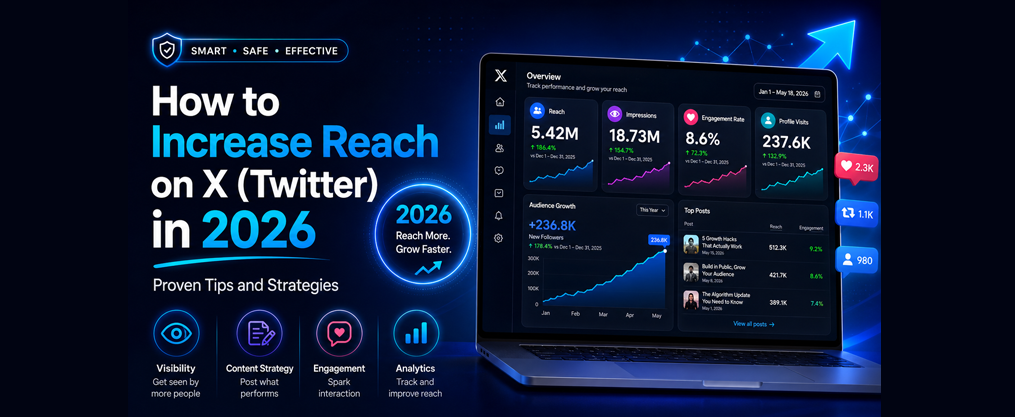
How to Increase Reach on X (Twitter) in 2026: Proven Tips and Strategies
Introduction
Are you searching for how to increase reach on X (Twitter) in 2026? This comprehensive guide is designed for creators, brands, marketers, and anyone aiming to expand their presence and influence on X (formerly Twitter). Inside, you’ll find actionable, data-backed strategies for boosting your reach, building a loyal audience, and driving real engagement. In 2026, increasing your reach on X matters more than ever—algorithm changes, evolving content formats, and fierce competition mean that only those with a clear, proven approach will stand out. Whether you want to attract clients, grow your brand, or become a thought leader, this guide covers everything you need to know to achieve sustainable traction and measurable results.
Proven Strategies for Traction on X (Twitter) in 2026
- Consistent posting, sharp positioning, and active engagement are essential for traction on Twitter in 2026—not just viral luck or random hashtag chasing.
- Aim to tweet 3–10 times per day, reply to others daily, and publish at least one strong thread per week to build momentum.
- Use Twitter analytics to identify your best-performing formats and optimal posting times for your specific audience.
- Profile clicks carry 24 times more weight than likes in signaling quality content to the algorithm, so optimize your profile for instant credibility.
- Combining organic tactics with occasional X Ads or collaborations can compress growth time from years to months.
When we talk about getting traction on Twitter, we’re not referring to a single viral tweet that disappears into the void after 48 hours. Real traction means consistent profile visits, steady follower growth, reliable link clicks, and inbound opportunities like clients, leads, or media mentions landing in your DMs. This is the foundation of sustainable Twitter growth, which relies on organic strategies such as consistent engagement, authentic content, and collaborating with micro-influencers to accelerate follower acquisition and build a loyal community.
Here’s the critical difference: vanity metrics give you a dopamine hit, while sustainable traction builds a foundation. A tweet getting 50,000 impressions represents nothing if your follower count stays flat and nobody clicks through to your newsletter. Sustainable traction means growth that compounds over 90+ days.
Measurable Targets for Your Twitter Account
- Reach 1,000 Twitter followers in 6 months
- Maintain a 1–2% Twitter engagement rate (A good Twitter engagement rate is typically between 1–3% for most accounts, with smaller accounts often seeing higher rates due to their focused audiences. Your Twitter engagement rate is calculated by dividing the total number of interactions on a tweet by the total number of impressions on that tweet.)
- Generate 5–10 profile visits per tweet
- Convert profile visits into 2–3 new followers daily
- Drive 10+ link clicks per promotional post
X now prominently displays metrics like views, reposts, and bookmarks on every tweet. Twitter views, or impressions, represent the number of times users see a post, and they are a key indicator of a post’s popularity alongside other metrics like retweets and likes. Impressions represent how many times your tweet has been seen, while engagement refers to actual actions taken by users, such as likes and retweets. Engagement metrics such as replies, retweets, and likes should be analyzed alongside views to gauge the overall success of Twitter posts and understand audience interaction. High engagement rates can help your tweets appear on more timelines, increasing your reach beyond your existing followers. Reposts indicate shareability—content others find worth spreading. Bookmarks signal high-value content people want to revisit. Using relevant hashtags can also increase a tweet’s reach by making it more discoverable to a broader audience. Together, these metrics paint a picture of whether you’re building genuine engagement or just shouting into the void.
To put this in perspective: growing from 200 to 1,500 followers on Twitter between March and June 2026 is entirely achievable if you apply the systems in this guide consistently.
Once you understand the importance of traction and the metrics that matter, the next step is to optimize your profile for instant credibility.
Optimize Your Profile for Instant Credibility
Most new visitors decide in under five seconds whether to follow your Twitter account. Your profile is your storefront, and a weak first impression means potential followers bounce before reading a single tweet.
Handle and Display Name
- Choose a clear, memorable Twitter handle that’s easy to remember and type.
- Use your real name or brand plus a niche keyword. For example:
- @AlexChenSaaS with display name “Alex Chen | B2B SaaS”
- @DesignByMaria with display name “Maria Santos • UI/UX”
- Avoid handles with excessive numbers, underscores, or obscure abbreviations. Your target audience should instantly understand who you are and what you do.
Profile Photo
- Use a high-resolution headshot or on-brand logo.
- Personal accounts perform better with real faces—people connect with humans, not abstract graphics.
- Avoid default avatars, low-quality images, or photos where your face is barely visible.

Bio That Converts
Your bio needs to accomplish three things in 160 characters:
- Position yourself clearly: “I help B2B startups turn cold outreach into warm leads”
- Add 1–2 proof points: “Ex-Shopify • 50K newsletter • Featured in TechCrunch”
- Include relevant hashtags if natural: #MarketingTwitter or #BuildInPublic
Here’s what an optimized Twitter profile looks like for a freelance designer: A professional headshot, display name “Jordan Lee • Brand Designer,” bio reading “I design brand identities that make startups memorable. Worked with 40+ founders since 2021. Free brand audit below ”, with a link to a Calendly booking page.
Pinned Tweet
- Pin your best-performing tweet or thread as a pinned post at the top of your profile.
- This should showcase your expertise, such as a January 2026 case study thread breaking down how you helped a client achieve specific results.
- Your pinned content is often the deciding factor for potential followers.
Link and Location
- Add a specific destination link—not your homepage, but a newsletter signup, landing page, or Linktree that captures visitors.
- Use the location field strategically if geography matters to your niche communities (e.g., “San Francisco” for tech, “Remote” for location-independent work).
Once your profile is optimized, the next step is to build a content system that consistently attracts views and engagement.
Build a Content System That Drives Consistent Views
Traction comes from systems, not random inspiration. The accounts that grow consistently in 2026 aren’t blessed with creative genius—they’ve built a repeatable social media strategy for X (Twitter) that produces valuable insights week after week. Growth on X comes from high-retention content and authentic community engagement, not just output. Maintaining a regular posting schedule of 3–5 tweets per day helps you stay active without burning out.
Content Mix Examples
A simple 80/20 mix works best: about 80% of posts should provide value, while 20% can be promotional.
To gain traction on Twitter, consistently post valuable, visual content such as images and videos, and use relevant hashtags. Each Twitter post should leverage images, GIFs, and videos to make it more eye-catching and shareable, maximizing engagement and visibility. Native videos and polls are effective engagement strategies on Twitter, taking minimal effort for users to engage with. (Native video content generates approximately 10 times more engagement than text-only posts.)
Weekly Content Rhythm
Here’s a baseline posting cadence that works:
- Daily: 3–10 tweets mixing formats
- Weekly: 1–2 Twitter threads diving deep into topics
- Sunday: 1 recap or “best-of” post summarizing the week
This creates a steady stream of Twitter content that keeps you visible in the Twitter feed without burning you out. That rhythm supports consistent posting and makes it easier to schedule posts with a content calendar or scheduler.
Three Content Pillars for Your Target Audience
Structure your content strategy around three pillars:
Pillar | Purpose | Example |
|---|---|---|
Education | How-tos, breakdowns, tutorials | “5 ways to write cold emails that get replies” |
Proof | Case studies, screenshots, results | “Here’s how I helped a client grow from 0 to $50K MRR” |
Personality | Opinions, behind-the-scenes, stories | “Unpopular opinion: most landing pages are too long” |
These pillars make creating content consistently easier instead of scrambling for ideas each day.
On Mondays, share 3 quick tips for junior developers. On Wednesdays, post a thread breaking down a 2025 product launch. On Fridays, drop an opinion piece about industry trends. This rhythm keeps content fresh while maintaining consistency.
Mix Your Formats
Don’t rely on the same content format or text-based posts alone. The algorithm favors variety:
- Text-only tweets: Quick thoughts, opinions, one-liners
- Image carousels: 3–5 images that post visual content; tweets with external links often underperform versus native posts, so test link placement carefully
- Twitter videos: Short clips under 2 minutes
- Polls: Every 3–4 days to drive interactivity
Twitter users engage differently with each format. Test what resonates with your audience by reviewing Twitter analytics weekly.
Transitioning from content creation, the next step is to ensure your tweets are crafted to capture attention and drive engagement.
Craft Tweets People Actually Stop to Read
Your content creation skills mean nothing if nobody stops scrolling. Writing tweets that capture attention requires understanding hooks, readability, and clear calls to action. Understanding Twitter’s algorithm is also crucial, as it prioritizes engaging and relevant content, making your tweets more likely to be seen and interacted with. Twitter engagement refers to the online interactions your tweets receive, including likes, replies, retweets, and shares.
The First Line Is Everything
Your hook determines whether Twitter users keep reading or scroll past. The optimal first-line hook length falls between 47–73 characters. Effective hooks include:
- Questions: “Stuck at 200 followers?”
- Bold claims: “Most marketing advice is wrong. Here’s what actually works.”
- Curiosity gaps: “I spent $10K on ads last year. Here’s what I’d do differently.”
- Personal stories: “I got fired in 2023. Best thing that ever happened.”
Keep It Scannable
Mobile feeds move fast. Use short sentences. Add line breaks. Avoid jargon.
Here’s what works:
- One idea per tweet
- Simple language a 12-year-old could understand
- White space between thoughts
- No walls of text
Effective Engagement Prompts
End tweets with action prompts that don’t feel pushy:
- “Reply ‘guide’ for the checklist”
- “Bookmark this for later”
- “Retweet to help another founder”
- “What would you add to this list?”
Questions and reply prompts are what turn passive views into real engagement.
Replies carry significantly more algorithmic weight than likes, with a ratio of 27 times more. This means that encouraging replies is one of the most powerful ways to boost your tweet’s reach and visibility.
Thread Structure Tips
Why Threads Dominate in 2026
Twitter threads increase dwell time—and dwell time exceeding two minutes on a tweet is 22 times more powerful than a like in signaling quality to the algorithm. When someone reads through your 15-tweet thread, they’re sending massive engagement signals that help your account gain traction.
Long-form threads of 15–25 posts can achieve 8–15 times more impressions than a single tweet when structured properly. Premium users can also test long form posts, but threads still need strong structure to hold attention. Start your thread with a compelling first tweet to capture attention and set the tone for the rest of the thread, using markers like (1/6) to indicate the beginning of a multi-tweet chain. Each tweet should deliver one actionable insight in scannable language, numbered sequentially (1/8, 2/8), ending with a call-to-action. Engagement velocity within the first 30–60 minutes of posting a thread can significantly affect how widely your content is distributed.
Mini Case Study: Thread Growth Example
Imagine a 10-tweet thread posted in April 2026 breaking down “How I landed 3 clients from Twitter DMs in 30 days.” If the first three tweets deliver fire hooks, this thread could move an account from 400 to 800 followers in a single week. That’s the power of structured, valuable content that creates engaging content worth sharing.
With your tweets crafted for engagement, it’s time to focus on timing, frequency, and understanding the X algorithm to maximize your reach.
Timing, Frequency, and the X Algorithm
Twitter’s algorithm favors recency, engagement signals, and relationship strength. Developing a comprehensive Twitter strategy that includes timing, frequency, and engagement tactics is essential for maximizing your reach and growth. Understanding these factors helps you significantly boost your visibility without gaming the system.
When to Post
Research suggests weekdays between 6–8 AM CST can make all the difference in early engagement, aligning with US time zone biases in the algorithm. However, your specific audience might differ.
Test different posting times for 2–3 weeks and review Twitter analytics to see when impressions and user engagement spike. Your optimal windows depend on where your target audience lives and when they scroll.
Posting Frequency
More posts (without spam) increase your surface area for discovery. Aim for:
- 3–5 scheduled tweets covering core content
- 2–5 spontaneous posts focused on posting content around relevant trends
- Continuous engagement throughout the day
Use schedulers like X’s native tool, Buffer, or Hypefury for core posts. Schedule tweets in advance, but leave room for real-time reactions to news and industry conversations. Maintaining a consistent presence matters more than chasing volume spikes.
The First 30 Minutes Matter
Early engagement strongly influences reach. The algorithm tests your tweet with a small audience first—if they engage, it pushes to more users.
Strategies to prime early engagement:
- Reply to every reply in the first 15 minutes
- Time posts when you can actively engage
- Ask friends or a small group to support new posts quickly
- Stay online for 30 minutes after posting important content
The goal isn’t to manipulate the algorithm—it’s to be present when your audience responds.
With your timing and frequency dialed in, the next step is to leverage hashtags, trends, and conversations to further amplify your reach.
Leverage Hashtags, Trends, and Conversations (Without Being Spammy)
Hashtags and trends can amplify reach, but traction comes from relevance, not volume. Using hashtags on Twitter categorizes your content and makes it accessible to users searching for specific topics. Stuffing tweets with popular community hashtags signals desperation, not expertise.
Participating in Twitter chats—interactive events that use specific hashtags—allows you to demonstrate your expertise, increase your visibility, and engage with communities and industry influencers regularly.
Hashtag Best Practices
Do this: Learn more about Twitter Threads and best practices.
- Use 1–2 carefully chosen relevant hashtags per tweet—the right hashtags for the topic and audience
- Pick industry hashtags your audience actually follows (#MarketingTwitter, #BuildInPublic)
- Use one branded hashtag if building a series
Don’t do this:
- Chain 5+ hashtags at the end of every tweet
- Use trending but irrelevant hashtags for exposure
- Repeat the same hashtags on every single post
Riding Trends Strategically
Check the “Explore” tab and Trending section daily for broader trends and trending hashtags. When you spot a relevant trend, tie it back to your niche with genuine commentary.
For example: during a January 2026 product-launch trend, you could add a short breakdown thread connecting the trending topic to your own SaaS case study. This positions you as a thoughtful voice, not an opportunist.
Valuable Replies Build Followers
Participation in niche conversations generates significant profile visits. Reply thoughtfully to larger accounts in your industry to reach new audiences with:
- Specific insights from your experience
- Data points or statistics
- Mini case studies
Consistent high-value replies help attract engaged followers, not just casual clicks.
Replies like “nice post ” or random emojis add nothing. Replies that provide industry insights or genuine engagement attract curious followers who click through to your Twitter profile.
After mastering hashtags and trends, it’s essential to make engagement a daily practice to accelerate traction.
Engagement as a Daily Practice, Not a One-Way Broadcast
Traction accelerates when you treat Twitter as a conversation, not a billboard. Broadcasting content without meaningful interactions is like speaking at a conference where everyone has headphones on.
Collaborating with influencers or content creators can also help expand your reach by leveraging their loyal following, who trust their recommendations and are more likely to engage with your content.
Daily Engagement Routine
Block 20–30 minutes daily for active engagement:
- Reply to 10–20 tweets in your niche
- Welcome new followers with genuine messages
- Respond to all mentions and relevant DMs
- Quote-tweet helpful content with added commentary
This routine also supports social listening by helping you spot recurring questions, objections, and topics in your niche.
This routine transforms you from “random account” to “familiar name” within your Twitter community over 60–90 days.
Ask Questions That Spark Conversation
Regular tweets should prompt responses:
- “What’s one mistake you made launching in 2025?”
- “Controversial take: [opinion]. Agree or disagree?”
- “Building in public this week. What should I share first?”
Reply to answers to deepen relationships. People remember accounts that engage with their responses.

Highlight Others Generously
Growth accelerates when you’re known as someone who elevates others:
- Retweet or quote-tweet helpful threads with genuine praise
- Shout out collaborators and industry leaders, tagging the creator’s handle when appropriate for visibility and credit
- Share user-generated content (with permission)
- Create “Follow Friday” posts featuring accounts you respect
Over time, this habit can also increase brand mentions as more people start referring to your account in conversations.
Host Live Audio Conversations
Consider hosting Twitter Spaces sessions—30-minute Q&As every Thursday in Q1 2026, for example. Twitter Spaces help you learn directly from your Twitter audience while building trust in real time. Live audio conversations create real-time connection with existing followers while attracting new followers through notifications and discovery.
With engagement as a daily habit, you can now explore collaborations, giveaways, and community plays to further expand your reach.
Collaborations, Giveaways, and Community Plays
Collaborating with similar-size or slightly larger accounts exposes you to new, relevant audiences. This isn’t about clout-chasing—it’s about mutual value exchange.
Collaboration Ideas
- Co-authored threads: Partner with another creator on a joint breakdown
- Joint Spaces: Host a February 2026 discussion on an industry report together
- Reply challenges: Both accounts answer audience questions in a thread
- Thread takeovers: Guest-post on each other’s accounts
When promoting collaborative resources or launches, Twitter Cards let you attach rich media, photos, and videos to posts, making them more visually compelling and improving click-throughs; you can also embed tweets in blog posts or partner pages to extend visibility.
Smart Giveaway Formats
Simple, non-spammy giveaways can drive follower growth when structured properly:
- “Retweet + follow to win a 30-minute consulting call”
- “Share your biggest 2025 lesson to enter for a free template pack”
- “Quote tweet with your hot take for a chance at a free course seat”
You can also embed tweets for giveaway or announcement posts in blog articles or partner pages to extend visibility beyond X.
Align prizes with your niche. A free audit or template attracts potential customers. A random gift card attracts random followers who’ll never engage again.
Community Coordination
Create small DM groups or Discord communities where creators support each other’s key tweets. This isn’t fake engagement—it’s ensuring your best content gets seen by people who genuinely want to see it.
Mini case study: A joint giveaway in May 2026 between two marketing accounts—each with around 2,000 followers—could generate 500 new followers for each account in a week when both audiences overlap in interests but not membership.
After leveraging collaborations and giveaways, it’s crucial to use analytics and experiments to double down on what works.
Use Twitter Analytics and Experiments to Double Down on What Works
Analytics prevent guesswork and help you increase engagement by showing which formats, topics, and posting times work best for your audience. Traction becomes easier when you know which formats, topics, and posting times generate more engagement with your specific audience.
Weekly Analytics Review
- Top tweets by impressions: What topics and formats performed best?
- Engagement rate: Which posts drove meaningful interactions?
- Profile visits: Which content made people curious about you?
- Link clicks: What converted attention into action?
- Visibility sources: When available, where did content appear most often, such as home timelines or search results?
Categorize Your Content
Tag tweets manually in a spreadsheet by category:
Category | Example | Performance Notes |
|---|---|---|
Tutorial | “5 steps to…” | High saves, medium reposts |
Opinion | “Unpopular take…” | High engagement, some negative |
Case study | “How I achieved…” | High profile visits, conversions |
Personal story | “I failed at…” | High engagement, emotional response |
After 4–6 weeks, patterns emerge. Maybe tutorials get saved but don’t drive followers, while personal stories generate profile visits. Adjust your content calendar accordingly.
Run Small Experiments
Change one variable at a time for 2 weeks:
- Test posting at 7 AM vs. 12 PM
- Compare hook formats (question vs. bold claim)
- Measure text-only posts against visual content
Compare results using average engagement rate and follower growth during each period, while tracking the same performance metrics in every test so comparisons stay meaningful.
Advanced Tools
Third-party analytics tools like Typefully, BlackMagic, or Hypefury provide deeper analytics on:
- Follower growth over time
- Best-performing tweet formats
- Optimal posting windows for your audience
- Engagement trends by day of week
Tools with sentiment analysis can help you spot whether certain topics trigger positive or negative reactions.
Set a 90-day review date. If you start in January 2026, review your progress by March 31, 2026, and adjust strategy based on what the data reveals.

With analytics guiding your strategy, you can now consider using X Ads to accelerate your traction once your organic systems are in place.
When (and How) to Use X Ads to Accelerate Traction
Organic growth is the foundation, but small ad budgets can speed up traction once your messaging is validated with Twitter Ads. Don’t throw money at promoting popular tweets until you know what actually resonates.
Starting with Ads
- Begin with a modest daily budget:
- $5–$10 per day for 10–14 days
- Use that budget to promote tweets or threads that already performed well organically
- Target interests and relevant keywords aligned with your niche
For example, target “email marketing” and “indie hacking” if you’re in the SaaS space—not broad demographics like “age 25–45.” Paid campaigns can extend reach beyond your current followers.
Measure What Matters
Track results in both Twitter Analytics and Google Analytics when measuring traffic and conversions:
- Profile visits from ad viewers
- New followers attributed to the campaign
- Website visitors from your landing page campaigns
- Downstream actions (signups, purchases, consultations)
Ads should amplify content already proven to work organically, not test untested ideas.
Once you have a solid organic and paid strategy, it’s time to put everything together in a focused action plan.
Putting It All Together: A 30-Day Traction Sprint
Here’s a concise action plan to gain Twitter followers and build momentum over the next month as part of a broader Twitter marketing plan.
Week 1 (Days 1–7): Foundation
- Optimize your Twitter profile completely (photo, bio, pinned tweet, link)
- Define your niche and target audience clearly
- Create a simple content calendar for the month
- Publish daily tweets and your first thread
- Document starting metrics: current follower count, average impressions per tweet
Week 2 (Days 8–14): Engagement Ramp
- Increase replies to other accounts (15–20 quality replies daily)
- Test 2–3 posting time windows
- Join at least one relevant Twitter space or live conversation
- Continue daily posting with mixed formats
- Actively engage with every reply to your posts
Week 3 (Days 15–21): Experimentation
- Run a small experiment (e.g., daily Twitter videos or image carousels)
- Collaborate with one peer account on a joint thread or Space
- Pin your best-performing tweet from the first two weeks
- Reach out to 3–5 accounts for future tweets collaboration
Week 4 (Days 22–30): Analysis and Planning
- Review Twitter analytics thoroughly
- Identify top-performing formats and topics
- Note which posting times generated better engagement
- Plan next month around what worked best
- Document ending metrics and calculate growth
Treat this 30-day sprint as a test. Compare your starting metrics against your ending metrics to see concrete progress. Did you gain more followers? Did your Twitter engagement rate improve? Did you receive any inbound opportunities?
Real traction often becomes noticeable after 60–90 days of applying these systems consistently. The first 30 days builds the habit. The next 60 days build the momentum. Stay patient, stay consistent, and let the compound effect work in your favor.

FAQ
How many tweets per day do I really need to post to get traction on Twitter?
A realistic range is 3–10 tweets per day, depending on your capacity and content quality. Posting 3 solid tweets with genuine engagement beats posting 10 mediocre ones with no follow-up. Quality and consistency matter more than hitting an arbitrary quota. Start with what you can sustain for 90 days, then scale up as you develop a rhythm.
Can I start a new Twitter account in 2026 and still grow, or is it too late?
It’s absolutely not too late. Late entry is fine on X, formerly Twitter, if you pick a clear niche, post consistently for at least 90 days, and engage daily with your target audience. The algorithm rewards consistent activity and valuable content regardless of account age. Accounts regularly gain 5,000–15,000 followers monthly in 2026 by applying proven tactics religiously.
Should I delete my old low-engagement tweets before trying to grow?
It’s usually unnecessary. Visitors primarily see your pinned tweet and recent posts. Focus energy on improving future tweets rather than curating old content. However, you can hide or delete obviously embarrassing posts and pin your best-performing content to create a stronger first impression for profile visitors.
How do I balance automation tools with staying authentic on Twitter?
Schedule core content using social media management tools like Buffer or Hypefury, but always leave time for genuine, real-time replies and conversations. A good ratio is 60% scheduled tweets and 40% live engagement. Your account should feel human—respond personally to comments, join spontaneous conversations, and react to trending topics when relevant.
What if I don’t have results or case studies yet for my niche?
Share your learning journey in real time. Document experiments, breakdowns, and discoveries as you go—this “building in public” approach resonates strongly on Twitter. You can also analyze public data, break down other social media platforms’ success stories, or share valuable resource recommendations while building your own proof. Your blog post about lessons learned often performs better than polished case studies because it feels authentic and relatable.