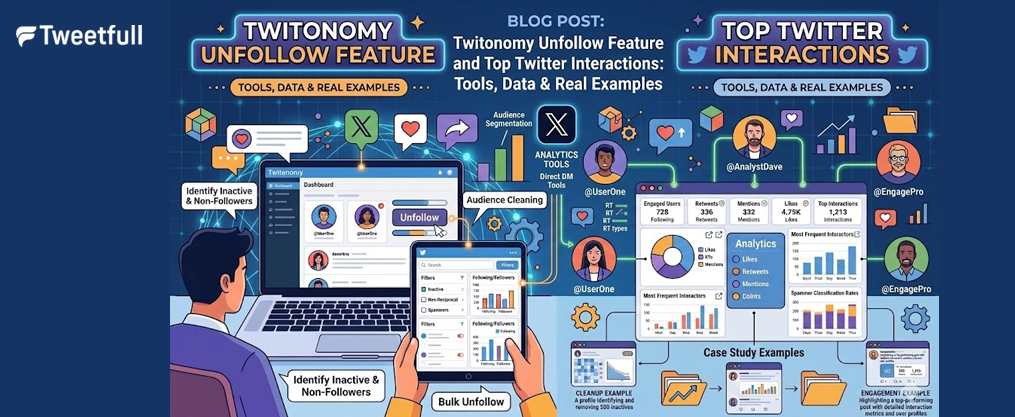
Twitonomy Unfollow Feature and Top Twitter Interactions: Tools, Data & Real Examples
Introduction
This guide is for Twitter users, marketers, and analysts who want to understand and manage their top interactions and connections using Twitonomy’s analytics and unfollow feature. Learn how these tools can help you optimize your Twitter presence and engagement. We’ll cover how to identify your most engaged connections, analyze your interaction data, and use Twitonomy’s unfollow feature to streamline your Twitter account management. Understanding and managing your interactions and unfollows is crucial for refining your Twitter strategy, building a more engaged audience, and ensuring your content reaches the right people.
Twitter/X doesn’t offer an official “top 10 interactions” list, but you can get remarkably close using analytics tools like Twitonomy, Circleboom, and the X API. Twitonomy’s free version offers basic analytics, and the free version of Twitonomy provides more features than many other Twitter analytics tools. Advanced features are available as an add on—optional features or services, such as extra Twitter reports or followers plans, that can be purchased to enhance the main plan for users who need deeper insights and customization. Twitonomy’s unfollow feature lets you manage your connections based on your interaction analytics, allowing you to unfollow accounts directly from its dashboard for efficient account management. Twitonomy allows users to export data into multiple formats, including Excel and PDF.
Tools such as Twitonomy can show who you interact with most over the past months, focusing primarily on replies, mentions, and retweets as core engagement signals, while also providing insights and a clear picture of your Twitter activity. Twitonomy provides detailed analytics for any Twitter user, including tweet monitoring and actionable insights through robust reporting. Twitonomy includes features for monitoring statistics and tracking competitors. Twitonomy offers a feature that visualizes tweets mentioning you on a world map.
Developers and power users can leverage the X Account Activity API and v2 endpoints to pull detailed interaction histories for followers, sometimes reaching back to 2020–2021 data if properly archived. These tools also track other metrics such as engagement rates, follower growth, impressions, and clicks.
High-engagement accounts like BTS, Harry Styles, and EXO demonstrate how interactions scale at massive levels—BTS averaged over 422,000 engagements per tweet in April 2019.
Privacy rules, data access caps, and API limitations mean you can infer but never definitively prove exactly why a specific follower decided to follow you. The free version offers enough analytics for most users, and the free version of Twitonomy provides detailed analytics about your followers and the accounts you follow. Add-ons can expand functionality with advanced features for those seeking more comprehensive data. Twitonomy is a free Twitter analytics tool that offers paid plans for additional features.
What “Top Interactions” on Twitter/X Actually Means
When people talk about top interactions on Twitter, they’re referring to the accounts you most frequently engage with through:
- Replies: Direct responses to someone’s tweet that appear in their mentions and create threaded conversations
- Mentions: Including another user’s username in your tweet (e.g., @handle), which notifies them
- Retweets and quote tweets: Sharing someone’s content with your followers, either as-is or with your own commentary added
- Likes: The lowest-friction positive interaction, signaling appreciation or agreement
- Profile clicks: When users visit your page after seeing your content
- Tweet count: Tracking how many tweets you or another user have sent or received, which helps assess account activity and engagement
- Actions on embedded media, cards, or external links you’ve shared
- Follows triggered by a tweet: New followers gained from a specific piece of content
This isn’t a single metric but rather a composite view of your social behavior on the platform, including your own activity and overall Twitter activity. Understanding this data can transform how you connect with your audience and refine your content strategy.
Most third-party tools rank your “top 10” based on interaction counts from a recent period—typically the last 1–9 months rather than your entire account history. These tools help you visualize and summarize the key things about your Twitter interactions, such as identifying your most engaged followers, spotting trends, tracking how many followers you have, and analyzing keywords for engagement and audience interests. Many analytics tools, including Twitonomy, also offer hashtag tracking to monitor and analyze hashtags, and provide insights into trending topics so you can stay updated on current popular discussions. You can also view your profile page for a summary of your own activity, including top tweets and engagement metrics. To learn more about how Twitter Threads can drive engagement and foster deeper online conversations, check out our detailed exploration. The total number of interactions gets calculated and sorted to generate your list.
It’s worth clarifying three distinct questions that often get confused. For those interested in maximizing social media impact, enhance your Twitter marketing with strategic list management for monitoring competitors and engaging your audience effectively:
- Who do I interact with most? The accounts you actively reply to, retweet, and mention
- Who interacts with me most? The followers and friends who consistently engage with your posts
- Who drives the most engagement on my tweets? Users whose interactions (comments, retweets) spark additional visibility
Making this distinction explicit helps you extract the right insights. For example, you might discover that @newsaccount appears in your “who I interact with” list because you frequently reply to their threads, while @superfan123 dominates your “who interacts with me” data because they never miss liking your content. Learning about top Twitter influencers can help you better identify and engage with the accounts driving those interactions.
How to See Who You Interact with Most Using Twitonomy
Twitonomy.com has been a go-to analytics tool for Twitter users who want to dig into their interaction patterns. The free version offers basic features, including access to recent interaction data and search analytics, making it useful for individuals and marketers who want actionable insights without cost. With the free version, you can typically view data covering roughly the last 9 months of activity, which is enough for most people to spot meaningful engagement trends.
The unfollow feature in Twitonomy enables users to unfollow accounts directly from the Twitonomy dashboard, streamlining the process of managing your Twitter connections based on interaction data.
Here’s how to access your top interactions data:
- Visit Twitonomy.com in your browser
- Sign in with your X/Twitter account and authorize the app
- Wait for the account scan to complete (this may take a few minutes depending on your activity volume)
- Navigate to the “Interactions” or “Most engaged users” section in your dashboard
- Review the ranked list of accounts you’ve interacted with most frequently
Twitonomy also allows you to follow or unfollow accounts directly from its interface, making it easier to manage your connections based on your interaction analytics.
The dashboard in the free version provides a selection of Twitter reports, such as lists of most engaged users and summary analytics. Premium plans unlock additional, more detailed Twitter reports and key Twitter metrics to track with advanced analytics, including extended historical data and deeper engagement breakdowns.
A free Twitonomy account historically shows up to 3–9 months of data, depending on how active you are. Premium tiers can dig back further—sometimes 1–2+ years of tweets—giving you a longer view of your engagement patterns.
As a concrete example, your top 10 list might look something like this after analysis:
Rank | Handle | Interaction Type | Period |
|---|---|---|---|
1 | @friend1 | 47 replies, 23 mentions | April 2023 – Jan 2024 |
2 | @brand2020 | 31 retweets, 18 replies | April 2023 – Jan 2024 |
3 | @newsaccount | 28 quote tweets, 15 replies | April 2023 – Jan 2024 |
This data reveals not just who you engage with, but how you engage with them. Some relationships are reply-heavy (indicating conversation), while others lean toward retweets (indicating amplification). |
Using the Twitonomy Unfollow Feature
After identifying accounts you interact with least or wish to remove, Twitonomy allows you to unfollow them directly from its dashboard, streamlining your account management. Simply locate the account in your interaction list and use the unfollow option provided by Twitonomy to manage your connections efficiently. This feature is especially useful for keeping your Twitter feed relevant and focused on the accounts that matter most to your engagement and strategy.
Limitations to keep in mind:
- Twitonomy can only access tweets still available via X’s API—deleted content won’t appear
- Direct messages are never included in public analytics
- Post-2023 API policy changes may affect how far back the free plan can see
- Very high-volume accounts may find their older data truncated
- The free version offers limited Twitter reports and search analytics compared to paid plans
If you are interested in more detailed engagement metrics and advanced analysis, explore Twitonomy’s premium features for deeper insights.

Creating a Twitter Interaction Circle (Tweetfull & Similar Tools)
A Twitter interaction circle is a visual graphic that places your account at the center and arranges your most-interacted-with accounts around you in concentric rings. Think of it as a social map showing who occupies your inner circle versus your outer orbit. These images have become popular to share on the platform as a great way to showcase your network, boost engagement, and acknowledge your community.
Take a moment to celebrate your connections by sharing your interaction circles and recognizing the value of your Twitter friendships.
Tweetfull’s Free Interaction Circle Generator makes this process straightforward and brings multiple engagement insights into one tool for your convenience:
- Visit the Tweetfull interaction circle generator page
- Sign in with your X account and grant the necessary permissions
- Let the tool analyze your recent activity (usually covering the last few weeks or months)
- Generate your circle image automatically
This tool helps users visualize and understand their engagement network, making it easier to identify key connections and patterns.
After generating your interaction circle, you can share it directly on Twitter or download it for other uses.
The tool typically offers two modes. To create your own tweet conversations, you can use a fake tweet generator.
- Activity-Based Circles: Weighted by a combination of likes, retweets, replies, and mentions from your recent activity window
- Count-Based Followers/Friends Circles: Pure interaction counts without any weighting applied
Here’s what this might look like in practice: imagine a user who sees @journalist, @game_dev, and @musicfan positioned in their inner ring. This placement happened because they exchanged replies with these accounts nearly every day during October–December 2024, making those relationships stand out from the rest.
Users commonly share these circles on X with shoutouts, using hashtags like #TwitterCircle or #InteractionCircle. This creates a form of public acknowledgment that often sparks reciprocal engagement—the people featured in your circle are likely to reply, retweet, or create their own circles in response.
The easiest way to generate one of these images is through Tweetfull’s interaction and engagement tools, though similar tools exist across the web. Just check that any tool you use has proper authorization through X’s official OAuth system rather than asking for your password directly.
Using the X (Twitter) Account Activity API to Trace Interactions
The Account Activity API is an official developer tool on the Twitter/X Developer Platform designed to capture real-time events like mentions, follows, replies, and direct messages. Its ability to provide real time tracking of Twitter events enables users to monitor live changes as they happen, offering immediate insights into audience interactions. For those willing to get technical, it offers the richest data access available for understanding interaction patterns.
Requirements to get started:
If you are interested in using Twitter data as a developer, learn more about Twitter API and Free Data Access To Developers.
- An approved X developer account with elevated access (per 2023–2024 policy)
- Setting up a webhook endpoint to receive activity notifications
- Subscribing a user account to receive its activity events
- Infrastructure to store and process incoming data
The API’s ability to capture a wide range of events is especially useful for monitoring daily growth in followers and engagement, allowing brands and creators to track campaign performance and audience expansion over time.
For historic interactions, you’ll typically need to combine the Account Activity API with REST or v2 endpoints. Exploring Twitter API features and limits alongside the conversations endpoint and user timelines endpoint lets you reconstruct when a follower last replied, retweeted, or liked your posts.
Consider this practical scenario from early 2021: a marketer notices they gained a new follower on January 6, 2021, and wants to understand what triggered that follow. By having stored follow events from the Account Activity API, they can cross-reference the follow date with their tweet history and previous replies/mentions. If that new follower had replied to three of their threads in the week before following, the answer becomes clearer.
Trade-offs to consider:
- API rate limits restrict how much data you can pull in a given time window
- You’ll need a database to store historical events from 2020–2024 for any longitudinal analysis
- Even with detailed logs, you can’t perfectly infer the exact point that made a user follow you—correlation isn’t causation
- The API requires ongoing maintenance as X updates its policies and endpoints
This approach demands more technical investment than using Twitonomy or Circleboom, but the depth of insight you can access—such as real time tracking, the ability to customize analytics, and monitoring daily growth—makes it worthwhile for serious analysts, brands, and developers building custom solutions.
Analyzing Followers’ Past Interactions Without Real-Time Data
A common problem emerged among users in early 2022: they wanted to analyze their existing followers’ historical behavior without having collected real-time data beforehand or a way to check and analyze Twitter followers in detail. If you didn’t set up the Account Activity API years ago, how do you reconstruct who among your followers engaged with you back in 2020 or 2021?
For non-developers, here’s a manual approach:
- Check a follower’s profile and visit their “Liked” tab to see if your tweets appear
- Use advanced search queries like from:@yourhandle to:@theirhandle since:2020-01-01 to surface old replies
- Search for your username in their tweet history to find mentions and quote tweets
- Save screenshots or notes as you find relevant interactions
For a more scalable approach:
- Request your official data export from X (Settings → Your Account → Download an archive of your data)
- Import your full tweet archive into a spreadsheet or analytics tool
- Use these official data exports to generate Twitter reports providing insights into historical engagement, such as which followers interacted most with your content.
- Compute per-follower metrics: number of likes, retweets, and replies between specific date ranges
- Cross-reference with your current follower list to identify your most loyal long-term supporters
Here’s an example of what this analysis might reveal: a brand in 2022 exports their tweet data and calculates that follower @sampleuser interacted 37 times across their campaigns—24 likes, 9 retweets, and 4 replies spread across 2020 and 2021. This person never appeared on their radar because they rarely replied publicly, but the like count tells a different story, providing insights into hidden engagement patterns.
The truth about retroactive analysis:
- Deleted tweets disappear from the record permanently
- Suspended accounts may have their interaction history become inaccessible
- API changes after 2023 mean some old interaction data may be missing forever
- Your data export captures your side of conversations, not comprehensive engagement metrics
This partial view is frustrating but inevitable. The rest of your analysis depends on what remains accessible through X’s current systems.
Real-World Examples of “Top Interactions” at Scale
Looking at massive accounts puts “top interactions” into perspective. When you’re wondering whether 50 retweets is good, consider what happens at the extreme end of the engagement spectrum. Data from around April 2019 reveals just how dramatically interactions can scale across social media platforms.
BTS (@BTS_twt) held the record as of April 29, 2019, with an average of approximately 422,228 engagements per tweet. This staggering number consisted primarily of retweets, though likes and replies contributed significantly. Their tweets didn’t just perform well—they dominated the platform.
Here’s how other top accounts compared during the same period:
Account | Handle | Avg. Engagements per Tweet |
|---|---|---|
BTS | @BTS_twt | ~422,228 |
Harry Styles | @Harry_Styles | ~115,559 |
Justin Bieber | @justinbieber | ~69,619 |
EXO | @weareoneEXO | ~44,758 |
These “engagements” include retweets, replies, likes, link clicks, profile clicks, hashtag taps, and tweet expansion views—mirroring how modern X Analytics defines engagement metrics today. In comparison to analytics tools for other social media platforms, these tools often track other metrics such as impressions, clicks, follower growth, and engagement rates, and help you experiment with getting more likes and retweets on Twitter, providing a more comprehensive view of social media performance. |
BTS’s follower count had reached approximately 19.6 million by April 2019, fueled by their global success with albums like “Love Yourself – Tear,” “Love Yourself – Answer,” and “Map of the Soul – Persona.” Their offline popularity created a ready audience eager to engage with every post, generating interaction volumes that smaller accounts can only imagine.
What makes this data useful for regular Twitter users? It establishes a ceiling and shows what’s possible when content, timing, and audience size align perfectly. Your engagement rate relative to your follower count matters far more than raw numbers.
How to Use Top Interaction Data to Improve Your Twitter/X Strategy
Once you know your top interactions, you can refine your content approach, network more effectively, and even support monetization efforts on X like subscriptions or ad revenue sharing. This data isn’t just interesting—it’s actionable.
Segment your top interaction accounts into categories:
- Friends: Personal connections you enjoy talking with
- Superfans: Followers who consistently engage but aren’t close friends
- Influencers: Accounts with larger followings who occasionally amplify your content
- Influential people: Users who have a significant impact in your niche or have large followings—identifying these accounts helps you create content that resonates with your broader audience and can boost your reach when they engage with your posts
- Customers: People who’ve purchased from you or expressed buying interest
- Press contacts: Journalists, bloggers, or podcast hosts in your space
Each category warrants different treatment. You might send DMs to influencers about collaboration, while superfans get public acknowledgment and thanks. Customers deserve prompt replies to their questions, and press contacts might receive early access to announcements.
Use interaction circles and Twitonomy reports to identify unexpected loyalists. These are people who liked and replied throughout 2022–2024 but never appeared on your radar because they didn’t fit your mental model of your audience. A quick scroll through your top 20 might reveal someone worth reaching out to directly.
Optimize posting times and content formats based on who engages:
- If your most engaged users are active in Europe around 18:00–21:00 CET, adjust your posting schedule accordingly
- If your top interactors respond most to thread content, create more threads
- If video generates replies from your core audience, prioritize video over static images
- Test polls and questions when you notice high reply rates from specific followers
Build stronger relationships proactively:
- Reply to your top interactors’ posts, not just your own
- Share their content when it’s genuinely valuable
- Tag them in relevant discussions where they can add expertise
- Follow back if you haven’t already
The people who interact with you most are giving you their attention repeatedly. That attention is worth cultivating. A single superfan who shares your content regularly might drive more new followers than a hundred passive observers who never engage.

Can I see an official “top 10 people I interact with” list inside Twitter/X?
No. As of 2024, X does not provide a built-in “top 10 interactions” feature anywhere in its native interface or analytics dashboard. You have to use third-party analytics tools, export your data manually, or build a custom solution with the X API to approximate this list. The platform shows you aggregate engagement metrics but doesn’t break them down by individual account.
How far back can tools like Twitonomy or Circleboom see my interactions?
On free plans, most tools work with only a slice of your timeline—often up to 3–9 months of recent tweets depending on your activity volume. Paid plans and custom API solutions can sometimes reach back multiple years, but they’re still limited by what the X API provides and your own archives contain. The longer you wait to start tracking, the more historical data becomes inaccessible.
Is it possible to know exactly why a specific user followed me?
Not with certainty. You can correlate the follow date with your tweets and previous interactions using analytics or the Account Activity API, but you can’t definitively prove which single action caused the follow. Someone might have seen your tweet, read your bio, checked your profile photo, scrolled your recent posts, and then decided to follow—the exact trigger remains a guess.
Do DMs count as “interactions” in these tools?
Public analytics tools and interaction circles usually ignore direct messages because DMs are private and not accessible through standard API endpoints. The official Account Activity API can surface DM events to your own app if you’re the account owner, but third-party dashboards rarely include them in public “top interaction” rankings. Your DM conversations remain separate from your public engagement metrics.
Can I analyze interactions for accounts I don’t own?
You can see public activity involving any public account—mentions, replies, retweets, and quote tweets that appear on their timeline. However, deep analytics that require account authorization (like full timeline access, protected tweets, or DM data) are only available if you control or have explicit permission for that account. You can learn a lot from public data, but the rich insights require ownership.
Best Practices for Twitter Management
Developing a Twitter Marketing Strategy
Effective Twitter management is the foundation of a thriving Twitter account and a powerful online presence. To get the most out of your Twitter profile, start by developing a clear Twitter marketing strategy for business that aligns with your brand’s goals. This means planning your content in advance, posting consistently, and engaging authentically with your followers.
Leveraging Analytics Tools
- Use relevant hashtags to boost the visibility of your tweets and join trending conversations that matter to your audience, applying Twitter hashtag best practices so your content reaches the right people.
- Leverage free Twitter tools to streamline your workflow—these tools can help you schedule tweets, monitor hashtag performance, and access detailed analytics about your account’s activity. Some analytics tools also offer email digests, which consolidate relevant social media alerts or updates into a scheduled email summary for easy review and monitoring.
- Regularly review your Twitter analytics and apply keyword and hashtag strategies for Twitter marketing to track engagement, follower growth, and the effectiveness of your content strategy.
Engaging with Your Audience
- If you notice inactive accounts among your followers, consider re-engaging them with targeted content or cleaning up your follower list to maintain a healthy, active community.
- A robust Twitter analytics tool provides insights into which tweets perform best, when your audience is most active, and what types of content drive the most engagement.
- Use these insights to refine your approach, experiment with new formats, and optimize your posting schedule.
- By focusing on engagement analytics and follower growth, you can build a loyal community and ensure your Twitter performance continues to improve.
Ultimately, adopting these best practices will help you create a vibrant Twitter profile that attracts new followers, fosters meaningful interactions, and supports your broader business objectives.
Common Twitter Management Mistakes
Inconsistent Posting
Even experienced Twitter users can fall into common traps that limit their Twitter growth and engagement. One frequent mistake is inconsistent posting, which can lead to a stagnant Twitter profile and cause followers to lose interest.
Neglecting Audience Engagement
Another is neglecting to engage with your audience—ignoring comments, mentions, or direct messages can make your followers feel undervalued and reduce overall engagement.
Ignoring Analytics
Many users overlook the power of Twitter analytics, missing out on valuable insights that could inform their Twitter strategy. Without regularly reviewing metrics and engagement data, it’s easy to repeat ineffective tactics or miss opportunities for improvement.
Lack of Team Collaboration
For businesses or teams managing multiple Twitter accounts, lack of team collaboration can result in inconsistent messaging and missed opportunities for coordinated campaigns. Not monitoring and adjusting your Twitter strategy based on analytics and performance metrics can further hinder your account’s growth and effectiveness.
By recognizing these common mistakes and making a conscious effort to avoid them, you can enhance your Twitter management, boost engagement, and achieve better results for your business or personal brand.
Managing Multiple Twitter Accounts Efficiently
Managing multiple Twitter accounts doesn’t have to be overwhelming—especially when you leverage the right tools and strategies. Whether you’re a social media manager juggling several brands, a business owner with different product lines, or an individual with personal and professional profiles, using a robust Twitter analytics tool can make all the difference.
A quality analytics tool allows you to track and analyze multiple Twitter accounts from a single, unified dashboard. This means you can monitor follower growth, engagement rates, and key metrics across all your accounts without constantly logging in and out. Features like real-time engagement tracking, consolidated analytics reports, and the ability to respond to comments and mentions from one place help you stay organized and efficient.
With these tools, you can easily identify trends and patterns unique to each account, compare performance, and adjust your Twitter marketing strategy accordingly. Scheduling and automation features further streamline your workflow, allowing you to plan content in advance and ensure consistent posting across all accounts. This not only saves time but also helps you maintain a strong, active presence that keeps your followers engaged.
By managing multiple Twitter accounts efficiently, you can maximize your reach, foster meaningful engagement, and drive growth for your brand or business—all while keeping your Twitter activity organized and actionable.
Scheduling Tweets for Maximum Impact
Scheduling tweets is a game-changer for anyone serious about their Twitter marketing strategy. By planning and queuing your tweets in advance, you ensure your content reaches your audience at the optimal times—even when you’re not online. This approach helps maintain a consistent posting rhythm, which is key to building engagement and growing your presence on Twitter.
A reliable Twitter analytics tool can help you pinpoint the best times to post by analyzing when your followers are most active and which tweets generate the highest engagement. With these insights, you can fine-tune your content strategy, schedule tweets for peak impact, and monitor performance metrics to see what’s working.
Scheduling features also allow you to batch-create content, freeing up time for real-time engagement and creative brainstorming. Whether you’re launching a campaign, promoting a product, or simply keeping your audience informed, automated scheduling ensures your tweets go out on time and in line with your overall strategy.
By leveraging analytics and scheduling tools, you can maximize the reach and effectiveness of every tweet, engage your audience more consistently, and drive better results from your Twitter marketing efforts.
Twitter Ads and Promotions for Growth
Twitter Ads and promotions are powerful tools for accelerating your Twitter growth, boosting engagement, and driving targeted traffic to your website or offers. With Twitter’s advertising platform, you can create highly targeted campaigns that reach your ideal audience based on interests, demographics, and behaviors.
When planning your Twitter Ads, it’s important to focus on clear objectives—whether that’s increasing your twitter followers, promoting a new product, or driving engagement with your tweets. Craft compelling ad creatives and set a budget that aligns with your business goals. Promoted tweets, Twitter polls, and other ad formats can help you capture attention and spark conversations.
A robust Twitter analytics tool is essential for tracking the performance of your ads. Use analytics features to monitor key metrics like impressions, clicks, engagement rates, and conversions. This data allows you to identify what’s working, optimize your ad strategy, and maximize your return on investment.
By integrating Twitter Ads and promotions into your overall Twitter marketing strategy, you can expand your reach, attract new followers, and achieve measurable growth for your business.
Twitter Customer Support and Help
Delivering excellent customer support on Twitter is essential for building trust, loyalty, and a positive reputation with your followers. Today’s Twitter users expect timely responses to their comments, mentions, and direct messages—making it crucial for brands and businesses to stay responsive and proactive.
Using a Twitter analytics tool, you can track customer support metrics such as response times, resolution rates, and the volume of support-related interactions. These insights help you identify areas for improvement and ensure your support strategy meets your audience’s expectations.
Features like chatbots and automation can streamline your support process, providing instant answers to common questions and ensuring 24/7 availability. This not only enhances the customer experience but also frees up your team to handle more complex inquiries.
By prioritizing customer support and leveraging analytics tools to monitor and improve your efforts, you can strengthen relationships with your followers, boost customer satisfaction, and drive long-term business growth through positive word-of-mouth and repeat engagement.
Twitter Account Security
Password and Authentication
Protecting your Twitter account is essential for maintaining your brand’s reputation and safeguarding your followers’ trust. Start by setting a strong, unique password for your Twitter profile and enable two-factor authentication (2FA) to add an extra layer of security.
Third-Party Tool Access
Regularly review your account activity for any suspicious behavior and be cautious when granting access to third-party tools—only use trusted applications that are essential for managing your accounts and follow key tips to keep your Twitter account secure.
Phishing and Account Monitoring
Be vigilant against phishing attempts by avoiding suspicious links and never downloading attachments from unknown sources. If you manage multiple Twitter accounts, restrict access to trusted team members and use a secure Twitter management tool to oversee permissions and activity. Keeping your Twitter app and browser updated ensures you benefit from the latest security enhancements and patches.
By prioritizing Twitter account security, you not only protect your own accounts but also demonstrate responsibility to your followers and business partners. A secure Twitter profile is the foundation for building lasting relationships and maintaining a positive online presence.
Conclusion
In conclusion, successful Twitter management requires a strategic blend of planning, analytics, and security. By developing a robust Twitter marketing strategy, leveraging free Twitter tools for detailed analytics, and focusing on follower growth, you can elevate your Twitter account and achieve meaningful engagement. Avoiding common mistakes—such as inconsistent posting, neglecting analytics, and poor team collaboration—will help you maximize your Twitter profile’s potential, whether you’re managing a single account or multiple Twitter accounts for a business.
Equally important is safeguarding your Twitter account with strong security practices to protect your brand and followers. As the Twitter landscape evolves, staying informed about new tools, trends, and best practices will ensure you continue to grow and engage your audience effectively. Embrace a comprehensive approach to Twitter management, and you’ll be well-positioned to achieve your business goals, foster community, and make the most of every tweet.
Free Twitter Tools for Engagement
Free Twitter tools are a game-changer for anyone looking to boost engagement and grow their Twitter followers without breaking the bank. These tools empower users to schedule tweets in advance, monitor mentions and conversations, and track hashtags relevant to their niche—all essential components of a successful Twitter marketing strategy. By leveraging free Twitter tools, you can streamline your workflow, maintain a consistent posting schedule, and ensure your tweets reach your audience at the right time.
One of the biggest advantages of using free Twitter tools is the access to basic Twitter analytics. These insights help you understand which tweets resonate most with your followers, identify peak engagement times, and spot trending hashtags that can amplify your reach. With this data, you can refine your content strategy, experiment with different tweet formats, and optimize your approach for better Twitter performance.
Free Twitter tools also make it easier to stay on top of your interactions. By tracking mentions and replies, you can quickly respond to followers, join relevant conversations, and build stronger relationships within your community. Hashtag tracking features allow you to participate in trending discussions and increase the visibility of your tweets, further enhancing your engagement.
Whether you’re a business aiming to grow your brand or an individual looking to expand your influence, incorporating free Twitter tools into your routine provides valuable analytics and actionable insights. These tools help you identify what’s working, adjust your strategy in real time, and ultimately drive more meaningful engagement on Twitter. Start exploring the wide range of free Twitter tools available today to elevate your Twitter presence and achieve your social media goals.