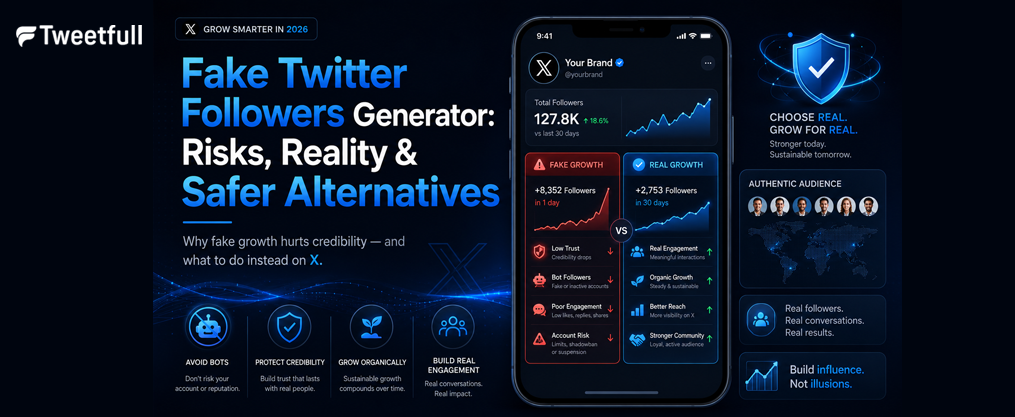
Fake Twitter Followers Generator: Risks, Reality & Safer Alternatives
Key Takeaways
- Section should be a short bullet-only summary; explain that “fake Twitter followers generator” tools flood your profile with low quality followers that hurt reach and credibility instead of helping.
- Mention that since X (formerly Twitter) tightened enforcement in 2018, mass fake follower purges (e.g., July 2018, late 2022) have repeatedly wiped out purchased followers overnight.
- Highlight that fake followers don’t see tweets, don’t send direct messages, and don’t buy-so follower growth from generators rarely leads to more engagement or sales.
- Stress that using bots and generators violates X’s automation and spam rules and can trigger shadowbans, reduced reach, or permanent suspension.
- Preview that the article will show how to detect fake followers, remove them, and replace them with organic followers using safer growth tactics.
Introduction to Fake Twitter Followers Generators
- Open with a short, explanatory paragraph defining what a “fake Twitter followers generator” is (websites, panels, and scripts that add thousands of artificial followers to Twitter X accounts in hours).
- Explain that these tools surged in popularity around 2013–2019 when follower counts became a vanity metric for influencers, brands, and politicians.
- Clarify difference between fake followers (bots, inactive accounts, click-farm profiles) and real followers and active followers who might discover an account organically.
- Note that after Elon Musk’s acquisition of Twitter in October 2022 and the rebrand to X in mid‑2023, bot and spam detection have become central in public debates, making generators even riskier.
- Set expectation that the article will cover how generators work, why they’re dangerous, real-case crackdowns, and how to pursue safer growth by building a twitter audience and improving a twitter profile instead.
How Fake Twitter Followers Generators Work
- Describe that most “fake Twitter followers generator” sites operate as SMM (social media marketing) panels that resell large bot networks and compromised accounts.
- Explain typical user flow: choose package (e.g., 5,000–50,000 followers), enter @handle, optionally connect API-based apps, pay via card/crypto, and see follower count spike within 24–72 hours; some third-party platforms market themselves as a tool or service for managing a twitter account.
- Mention API-based Python scripts and Chrome extensions that automate follow/unfollow cycles to simulate growth, often shared on GitHub since about 2015; some competing platforms also promote mass following with advanced search filters, with Circleboom as one example.
- Clarify that these followers usually have generic avatars, random handles (e.g., @user84392019), few tweets, and follow thousands of accounts to appear less robotic.
- Emphasize that these tools ignore audience fit: they don’t target niche, language, interests, similar interests, the right audience, or relevant keywords, so follower growth is purely cosmetic and algorithmically suspicious.
Common Types of Fake Followers You Get
- Outline that this section should be a short intro plus bullets grouping fake followers into concrete types with clear on-profile signs, noting these mixes often include fake accounts and spam accounts, not just generic low quality profiles.
- Describe “empty shell” accounts: no bio, default or stolen profile picture, 0–3 tweets, created recently (e.g., all joined in 2025–2026) but already following thousands.
- Describe “recycled bot” accounts: reused profiles that retweet random viral content, post generic quotes, and rotate through different languages to evade filters.
- Describe “compromised real” accounts: once-active users whose credentials were stolen; they look real (older join date, real photos) but suddenly follow hundreds of unrelated profiles.
- Explain that generators often mix these categories to bypass simple fake follower checkers, but engagement behavior still reveals they are low quality followers.
Why People Still Search for Fake Twitter Followers Generators
- Briefly explore motivations: social proof, impatience, and pressure from brands and clients that ask for “more followers” as a success metric.
- Explain that creators, especially in 2024–2026, often feel behind when they see viral X accounts hitting 100k+ followers seemingly overnight and assume they must also inflate numbers.
- Mention typical use cases: launching a new SaaS, trying to look credible before a Product Hunt launch, or creators, public figures, and businesses believing inflated numbers may attract partnerships or potential customers.
- Note the psychological bias: a profile with 50,000 followers looks more trustworthy at first glance than one with 500, and a high follower count can seem useful for attracting attention from new users, even if the large account has mostly fake followers.
- Preview that later sections will demonstrate how short-term image gains are outweighed by lasting damage to reach and trust.
Real Risks of Using Fake Followers Generators on X (Formerly Twitter)
- State that this section should emphasize concrete, platform-level risks supported by policy references and historical purges.
- Explain that X’s rules on platform manipulation and spam explicitly prohibit buying or selling fake engagement, automated follows, and bulk account creation, and no third-party service can guarantee your account remains secure when it depends on fake growth or prohibited automation.
- Mention that in July 2018 Twitter removed tens of millions of suspicious followers in a single purge, causing celebrities to lose up to 5–10% of their follower base overnight.
- Describe possible penalties in 2024–2026: follower removals, limited tweet visibility (shadowbans), blocks on following new accounts, and permanent suspension for repeat violations.
- Highlight financial and reputational risk: losing a verified business account, paid partnerships, or advertising access if brands detect inflated, fake follower metrics.
How Fake Followers Damage Your Account’s Growth
- Section should connect fake followers directly to reduced account’s growth and poorer performance in the X algorithm.
- Explain engagement rate math: if an account has 50,000 followers but only 200 real active users, likes and replies per tweet look extremely low, signaling low relevance to ranking systems.
- Describe how X’s recommendation systems (For You timeline, search, and suggested follows) favor tweets that get early engagement; fake followers never engage, so posts underperform.
- Note that fake followers distort analytics dashboards: impressions, click-through, and conversion data tied to your website and other campaign destinations become unreliable, making it harder to optimize campaigns.
- Mention that advertisers and brand partners now commonly ask for screenshot or API-based proof of real engagement, not just follower count, exposing fake twitter followers quickly; an inflated count also weakens efforts to attract the right audience to a twitter page.
Impact on Engagement, Direct Messages, and Social Proof
- Clarify that this section should zoom in on the micro-level consequences for everyday interactions on X, which are very different from one-off visuals you might create with a fake tweet generator.
- Explain that fake followers rarely like, reply, or retweet, so tweets receive less real-time engagement, lack authentic engagement, and therefore get shown to fewer people, creating a negative feedback loop.
- Describe that direct messages from real prospects, clients, or collaborators decline because the algorithm stops surfacing tweets to interested active users, which also makes it harder for genuine connections to form with people who share your interests.
- Point out that savvy users and agencies routinely run fake follower checks; when they see 60–80% fake, they may avoid partnerships, guest posts, or sponsorships.
- Note that in some niches (marketing, finance, politics) being exposed with a large number of fake followers can generate public backlash, damage the wider community around an account, and cause long-lasting reputational harm—another reason to favor genuine engagement over fake or bot followers.
Case Studies: Crackdowns on Fake Twitter Followers
- Section should contain narrative-style bullet points summarizing specific, dated clean‑ups that show generators are always temporary advantages.
- Describe the 2018 Twitter “locked account” purge where high-profile accounts like @BarackObama and @katyperry lost hundreds of thousands of followers in a single week.
- Mention ongoing “bot sweeps” reported by users in late 2022 and 2023, soon after Elon Musk cited estimates that 5–20% of accounts could be spam or fake.
- Highlight that each sweep targeted patterns common to generator-fed accounts: sudden surges of followers created in the same month, similar bios, and identical following ratios.
- Conclude that any account leaning on fake twitter followers generators is essentially renting followers that can disappear without warning whenever X tightens detection rules.
How to Check If You Already Have Fake Followers
- Use free audit tools and a manual review together. Tools similar to Fedica’s Twitter Audit or legacy options like Status People’s Fake Follower Check usually sample a portion of your audience and estimate the percentage of suspicious accounts, which you can then address with organic Twitter growth tools and services.
- Then manually scan your followers list for obvious red flags: no profile photo, no bio, foreign-language bios unrelated to your niche, or strange follower/following ratios such as following 5,000 accounts but being followed by only 7; for example, flag clusters of nearly identical usernames or empty profiles created around the same date.
- If your account has under 100,000 followers, sampling roughly 500 to 1,000 profiles can still give you a fairly accurate read on fake follower density, much like early audit tools showed.
- Save before-and-after screenshots from each audit so you can measure whether your follower growth is improving in quality over time, and keep a simple log of audit dates and results as you clean up your audience.
Key Red Flags of Low Quality Followers
- Section should be bullet-only, listing concrete on-profile signs writers can turn into examples or screenshots.
- Mention accounts with usernames full of numbers (e.g., @john73294810) created in 2025–2026 with no consistent posting pattern.
- Highlight followers with generic bios (“I love life”, “happy person”, “crypto investor”) that are identical or extremely similar across many profiles.
- Point to timelines packed with only retweets or promotional links, no replies, and no genuine conversation with other users.
- Note clusters of followers that all joined within a few days, follow the same set of large accounts, and never interact with your content.
- Explain that these signs, in combination, almost always indicate low quality followers sourced from generators or cheap follower services.
How to Remove Fake and Bot Followers Safely
- Describe that this section should present step-by-step cleanup guidance, focusing on safe, gradual removal rather than aggressive mass actions.
- Explain manual approach: block then quickly unblock suspicious accounts so they no longer count as followers, spacing actions out to avoid triggering X rate limits.
- Mention using follower management tools (where compliant with X’s current policies) that label likely fake or inactive followers and allow batch actions in small, safe batches.
- Advise prioritizing removal of the most obvious fakes (zero tweets, no avatar, unrelated language spam) before moving to gray-area accounts.
- Recommend scheduling cleanup over weeks, not hours, so that X’s systems see normal maintenance behavior rather than suspicious mass pruning.
Why Free Twitter Followers Offers Are Usually Not “Free”
- Section should relate fake follower generators to “free twitter followers” campaigns that often serve as entry points into the same ecosystem, contrasting them with more reputable options if you ever consider buying X followers.
- Explain that many sites promising 10–500 “free followers” in exchange for email or profile link are sampling from the same bot pools used in paid campaigns.
- Mention common hidden costs: aggressive email marketing, upsells to larger paid packages, or forced engagement in follow‑for‑follow loops with other low quality accounts.
- Highlight possible data risks: connecting third‑party apps that request read/write permissions, enabling them to post tweets, send DMs, or follow/unfollow without clear consent.
- Advise readers to treat any offer of instant free twitter followers with caution and to review app permissions on X regularly to revoke suspicious access.
Ethical and Legal Considerations of Fake Twitter Followers
- Section should briefly cover ethics, advertising standards, and potential contractual issues for influencers and agencies.
- Explain that inflating follower numbers for sponsorships can be considered deceptive advertising, especially in regulated industries like finance or health.
- Mention that some brand contracts since around 2020 explicitly forbid using fake followers or engagement, allowing advertisers to cancel deals if audits reveal fraud.
- Note that in regions with strict consumer protection laws (e.g., EU, UK), misrepresenting audience size to sell services or products can draw regulatory scrutiny.
- Encourage transparency with partners: share realistic follower quality reports and focus on real engagement metrics (clicks, sales, qualified leads) instead of vanity numbers.
Building Organic Followers Instead of Using Generators
- Organic followers are the opposite of fake followers. They are real people who find your account through content, search, or recommendations and choose to follow because of shared interests, which is what organic growth looks like in practice rather than manipulation.
- This kind of follower growth is slower, but it compounds. Each engaged follower increases the chance that future posts reach new people, helping build a stronger Twitter audience through real followers who support long-term growth.
- That compounding effect matters more on X today than raw follower count. Since the platform’s 2023 algorithm changes, high-quality interactions like replies, saves, and longer dwell time tend to carry more weight than inflated numbers, so stronger relevance can support your presence effortlessly over time, not instantly.
- In practice, a smaller real audience often beats a larger inactive one. If people actually read, reply, and share, your account is more likely to earn impressions, clicks, and conversions than one padded with low-quality accounts.
- That is why the next sections focus on sustainable, repeatable tactics. The goal is to grow with signals the platform can trust instead of leaning on fake twitter growth hacks.
Safer Strategies to Get More Followers on X
- Section should be a bullet-style playbook listing practical tactics writers can flesh out with examples, screenshots, or templates, drawing on proven methods to grow your Twitter followers in quick time.
- Encourage posting consistently around 1–3 core topics, so the algorithm and users both “understand” what the account is about.
- Suggest joining existing conversations in your niche by replying thoughtfully to larger accounts’ tweets instead of only broadcasting your own posts; some automation tools market themselves as a game changer for reaching the right audience, but volume-based tactics can quickly cross into risky behavior.
- Recommend using X features like long-form posts, threads, polls, and native video to test what drives more engagement and saves with your specific audience, combining them with effective strategies to boost your followers on Twitter.
- Advise collaborating with similar-sized creators through shoutouts, joint threads, and Spaces to cross-pollinate audiences without using fake follower tricks.
- Note that some services advertise aggressive capacity, such as Circleboom processes up to 400 follow requests daily, as a reminder to prioritize compliance over scale.
Optimizing Content for Genuine Follower Growth
- Explain that this section should focus on tweet-level improvements that move metrics the algorithm cares about, like engagement and watch time, so you can systematically increase Twitter impressions.
- Suggest crafting hooks in the first 1–2 lines of tweets and threads that promise a clear benefit or curiosity gap (e.g., “In 2026, this is the only X growth tactic that still works without bots…”).
- Advise mixing educational content (how‑tos, frameworks, checklists), opinion pieces (takes on news or industry shifts), and proof posts (case studies, screenshots) for credibility.
- Encourage including occasional calls-to-action asking real users to follow, bookmark, or reply, while avoiding spammy “follow train” or mass-tag schemes.
- Recommend tracking which posts drive the most new followers in analytics so you can double down on proven formats rather than chasing random virality.
Using Analytics to Monitor Follower Quality Over Time
- Section should connect analytics to quality, not just volume, and show how to detect issues before they become critical.
- Explain which X metrics matter most for follower quality: engagement rate, profile visits per impression, and ratio of followers gained to link clicks or email signups.
- Suggest conducting quarterly follower audits with a fake follower checker or manual sampling to ensure low quality followers aren’t creeping back in.
- Mention that sudden spikes in followers without corresponding rises in impressions or engagement can indicate that someone on the team bought followers or that the account was botted.
- Recommend setting internal thresholds (e.g., keeping estimated fake followers under 10–15%) and taking action quickly if metrics cross that line.
How Agencies and Brands Should Evaluate Fake Followers
- Section should be aimed at marketers, PR teams, and brands that hire creators or manage multiple client accounts.
- Advise running fake follower checks on potential partners, comparing follower growth charts to campaign timelines to spot unnatural jumps.
- Suggest requiring anonymized screenshots of X analytics (impressions, link clicks, follower growth) as part of vetting influencers or B2B creators.
- Explain that modest but steady follower growth and strong engagement signals are more valuable than suspicious surges followed by long flat periods.
- Encourage including clauses in contracts that allow adjustments or termination if an account is later found to have a high percentage of fake followers.
When You’ve Already Used a Fake Followers Generator: Recovery Plan
- Section should provide a simple, reassuring roadmap for readers who admit they already bought fake followers and now want to fix it.
- Step 1: Stop all generator and SMM panel orders immediately; revoke access for any suspicious third‑party apps in X’s security settings.
- Step 2: Run a baseline audit to estimate current fake follower percentage and save results for comparison after cleanup.
- Step 3: Begin gradual removal of the worst fake followers, combining manual pruning with safe, policy-compliant tools if available.
- Step 4: Shift content strategy toward consistent, high-quality posting and genuine engagement to retrain the algorithm on real active users.
- Step 5: Accept that follower count might go down in the short term, but emphasize to readers that raising engagement rate and trust is what unlocks long-term growth and monetization.
Conclusion: Choose Long-Term Trust Over Fake Twitter Growth Hacks
- Section should summarize the main arguments in a concise, persuasive way that discourages using any fake twitter followers generator.
- Reiterate that generating fake followers creates a fragile illusion: they can be wiped by the next X bot purge, damage metrics, and erode real opportunities.
- Emphasize that in 2026, brands, agencies, and savvy users care more about engagement, conversions, and conversation quality than raw follower counts.
- Encourage readers to treat their X presence as a long-term asset: clean up fake followers, focus on organic followers, and build an audience that actually responds, buys, and advocates.
- End with a call to action to run an honest audit today and commit to never relying on fake follower generators again.
Frequently Asked Questions
- Section should contain a brief intro sentence followed by h3 questions with short, direct answers that cover angles not fully addressed above.
- Ensure answers reference concrete behaviors and platform realities instead of generic social media advice.
- Keep the total number of FAQ questions between 3 and 5 for clarity and focus.
- Avoid repeating earlier sections verbatim; instead, clarify common edge cases (e.g., small amounts of fake followers, legal worries, and recovery timelines).
Is it ever safe to use a fake Twitter followers generator if I only add a small amount?
- Explain that even a small purchase technically violates X’s rules on platform manipulation and can still hurt engagement rates if the new followers never interact.
- Note that today’s “small” test often becomes a habit; once users see a number jump, they are tempted to repeat it rather than fix content and engagement strategies.
- Emphasize that the safest amount of fake followers is zero and that every budget dollar is better spent on content, ads, or collaborations that reach real people.
Can I be banned just because I have fake followers?
- Clarify that X typically focuses on the behavior (buying and using generators) rather than simply having some fake followers, since most accounts accumulate a few over time.
- Explain that bans are more likely if the account uses aggressive automation, mass following, or repeated purchases that clearly manipulate metrics.
- Advise documenting cleanup efforts and avoiding any future generator use to reduce risk and demonstrate good-faith compliance.
How long does it take to recover engagement after removing fake followers?
- State that recovery time varies, but many accounts see improved engagement rates within 4–12 weeks of consistent cleanup and higher quality posting.
- Explain that the algorithm needs time to re-evaluate your content based on fresh interactions from real active users, not from old, inactive bots.
- Recommend tracking changes in impressions per follower and average replies per tweet as primary indicators that recovery is underway.
Do I need to tell brands or clients that I used fake followers in the past?
- Suggest that if fake followers materially inflated reported metrics in previous deals, transparency is the most ethical approach, especially in long-term partnerships.
- Encourage shifting focus in future reports toward verifiable KPIs like clicks, conversions, and revenue, which are harder to fake than follower counts.
- Explain that many brands care more about your plan to fix the issue and your current engagement quality than about past mistakes, as long as they are not ongoing.
What’s the difference between follow-for-follow and fake followers generators?
- Clarify that follow-for-follow (f4f) involves real users agreeing to follow each other, while generators usually deliver bots or compromised accounts, and that even the best follow for follow Twitter strategies carry risks if abused.
- Explain that large-scale f4f networks still create low quality followers who rarely engage, so they can also hurt algorithmic performance even if they aren’t bots.
- Recommend being selective with follow‑for‑follow, focusing only on genuinely relevant accounts in your niche and avoiding mass f4f chains or hashtags.