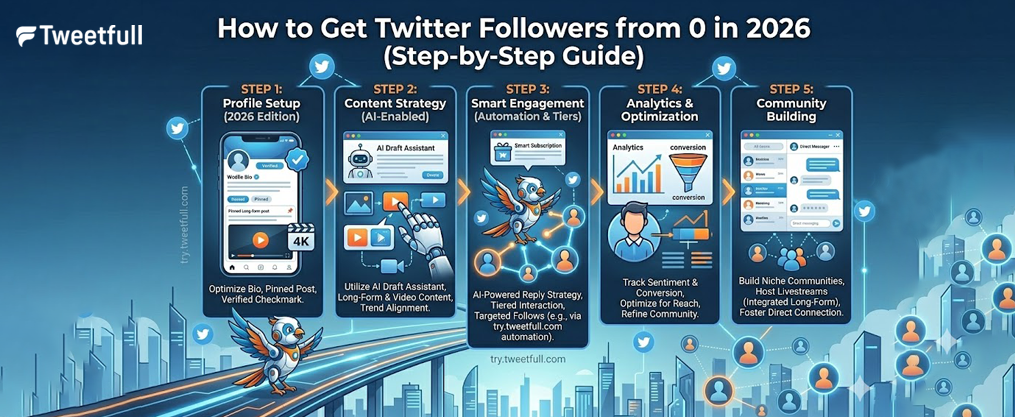
How to Get Twitter Followers from 0 in 2026 (Step-by-Step Guide)
Starting a Twitter account from scratch in 2026 can feel like shouting into the void. In the beginning, every post feels like it disappears without engagement, making it hard to know if anyone is even seeing your content. Your tweets get almost no impressions, and growth seems impossibly slow. The good news? Building a real audience from zero followers is absolutely achievable—you just need the right strategy.
This blog post breaks down the exact system for growing your Twitter account from 0 to 1,000 followers, focusing on what actually works in the current algorithm landscape.
Key Takeaways
- To grow followers on X (formerly Twitter), focus on strategies tailored to the platform, including engagement, content creation, and profile optimization.
- Track how many followers you have as a key milestone—setting goals like reaching your first 1,000 followers helps measure progress and motivates consistent effort.
- Key strategies for building a Twitter following include creating a compelling bio, posting daily, and engaging with industry leaders.
- From zero followers, comments and profile optimization matter more than posting volume. Focus 80% of your effort on engaging with others and 20% on your own posts.
- One high-quality tweet per day plus 30–60 focused comments daily for your first 60–90 days will outperform posting 10 random tweets with no engagement.
- Optimize your X profile (photo, bio, banner, pinned tweet) so new visitors instantly understand why they should follow you—this alone can increase follow conversion rates by 20-30%.
- Engage with bigger accounts in your niche using thoughtful, non-spammy replies to “borrow” their audience and build relationships with their followers.
- Buying followers or posting randomly will slow your growth and hurt long-term credibility—brands and partners now routinely check engagement ratios, not just follower counts.
Introduction to Twitter: What Makes It Unique in 2026
Twitter, now widely recognized as X, continues to stand out as the go-to platform for real-time conversations, rapid idea validation, and building meaningful connections. In 2026, Twitter’s unique blend of immediacy and public discourse makes it a game changer for anyone looking to grow their audience and increase their influence. Unlike other social networks, Twitter’s algorithm rewards posts that spark engagement and keep people talking—especially around trending topics and timely discussions.
What sets Twitter apart is its ability to amplify your voice quickly. A single tweet can reach thousands if it taps into the right conversation or trending topic. The platform’s focus on time spent engaging with posts, as well as the rise of video and multimedia content, means that a well-crafted tweet or thread can drive significant visibility and follower growth. Whether you’re a business, creator, or thought leader, Twitter offers a direct line to your target audience and a chance to showcase your expertise in real time.
To grow Twitter followers in 2026, it’s essential to develop a content strategy that leverages these unique features. Focus on creating posts that invite replies, encourage sharing, and tap into what’s trending in your niche. Consistent engagement—both on your own tweets and on other people’s posts—remains the best strategy for increasing your reach and building a loyal following. By understanding what makes Twitter unique and aligning your approach with the platform’s strengths, you can maximize your post’s visibility, drive more engagement, and accelerate your follower growth.
Why Growing from 0 Followers Feels So Hard (But Is 100% Possible)
The 0–1,000 stage feels discouraging because your tweets initially reach almost nobody. When you have zero x followers, the algorithm has no data about your content quality, no engagement history to reference, and no reason to show your posts to anyone outside your immediate network. You’re essentially invisible.
In early 2026, X (formerly Twitter) prioritizes content that already has engagement. The platform’s algorithm rewards tweets with high reply-to-like ratios and distributes content in phases—initial engagement from a small network triggers broader exposure to non-followers. Early engagement is crucial because it significantly boosts your post’s visibility, making it more likely to be seen by a wider audience. Without that initial network, your great content sits unseen.
Here’s a concrete example: a new account created in January 2026 posting five times a day with no comments on other people’s posts will stay invisible for weeks. Meanwhile, an account posting once daily but spending 45 minutes commenting thoughtfully on larger accounts starts seeing profile visits within days. Commenting on other people’s posts is a proven way to increase visibility for new accounts. The difference isn’t the content quality—it’s the strategy.
Treat your first 90 days as a testing and networking phase, not a popularity contest. Your goal isn’t viral fame immediately. It’s building the foundation that makes viral moments possible later. The accounts that grow fastest from zero understand this mindset shift: you’re investing in relationships and visibility, not just broadcasting into the void.
Step 1: Set a Clear Goal and Pick Your Niche
One of the biggest mistakes new accounts make is tweeting about everything. When your feed jumps from fitness tips to cryptocurrency opinions to restaurant reviews to political commentary, potential followers can’t figure out what they’ll get by following you. A confused visitor doesn’t click follow—they scroll past.
Picking a specific niche makes your account instantly more valuable to the right audience. Consider these concrete examples: “AI tools for marketers” attracts a different crowd than “bootstrapping SaaS” or “freelance design tips” or “fitness for busy parents.” Each niche has a clear target audience with specific problems they want solved.
Your goal for the first 90 days should be specific and measurable. Instead of “get more followers,” aim for something like 500–1,000 targeted followers plus 3–5 high-intent DMs per month from potential clients or collaborators. This gives you a target to work toward and a way to measure whether your content strategy is actually working.
Before you post anything, answer these questions: Who do I want to help? What problem do I solve better than most? What outcome do I talk about repeatedly? What topics could I discuss for years without getting bored? Your answers form the foundation of your content pillars and help you write posts that attract the right followers—not just more followers.
Step 2: Optimize Your Twitter Profile for Instant Trust
Most people decide in under three seconds whether to follow you after seeing a reply or post. They click your profile, scan your photo and bio, and make a snap judgment. On x twitter, optimizing your presence is crucial for growth and engagement. A clear bio and professional visuals are essential for optimizing your Twitter profile. Visitor judgment on your value proposition happens within seconds upon visiting your profile. Your profile should communicate why someone should follow you in 3 seconds. Think of your profile as your digital storefront—a poorly optimized profile can lead to missed opportunities. An optimized profile can convert 20-30% of visitors into followers. A weak profile loses them forever.
Think of your profile as a mini landing page. Every element—your profile picture, bio, banner, link, and pinned post—should work together to communicate who you are, what you offer, and why someone should care.

Profile Picture: Look Like a Real, Trustworthy Human
Your profile picture is often the first thing people notice. Use a clear, well-lit headshot from chest up, facing the camera, with a neutral or slight smile. This signals that you’re a real, approachable human—not a bot or anonymous troll.
Avoid busy backgrounds, group photos, memes, or low-resolution selfies for growth-focused accounts. These create friction and make you look less professional. A simple improvement: shoot on your iPhone or Android near a window during daytime, use a plain background, and crop the image square. This takes five minutes and dramatically improves your first impression.
Use the same photo across LinkedIn, your website, and other platforms to build recognition. When someone sees your reply on a larger account’s tweet and then spots your comment elsewhere, that visual consistency builds familiarity and trust over time.
Bio: Who You Are, What You Do, Outcome You Deliver
Your bio has 160 characters to convince someone to follow you. Use this formula: “I help [who] [do what] so they can [result].”
Here’s a bad bio versus a better one. Bad: “Dreamer. Coffee lover. Hustling in silence.” This tells a visitor nothing about why they should follow you. Better: “I help solo founders land their first 10 customers using X and cold outreach. Building in public.” This clearly states the target audience, the outcome, and what to expect from your content.
Another example for a different niche. Bad: “Just a mom trying to figure it out.” Better: “Helping busy parents get fit in 20 min/day. Lost 40 lbs after kid #2. Free workout guide below.” Notice how the better version includes a credibility point (the personal result) and a clear value proposition.
Limit your bio to one clear value line plus one credibility point when possible. If you’re “Ex-Shopify PM” or have a “50K+ newsletter,” mention it. Social proof helps new visitors trust you faster.
Banner: Reinforce Your Promise or Personality
Your banner image is prime real estate most accounts waste with a random photo or leave blank entirely. You have two solid options: a business banner with your value proposition, social proof, and call to action, or a personality banner showing your city, hobby, or brand colors that gives people a sense of who you are.
For a business-focused banner, try something like: “Grow your SaaS MRR using X and email — Free weekly playbooks at [your URL].” This reinforces your niche and gives visitors a reason to click your link.
A simple design option: use a free Canva template with one background color, one line of text, and optionally your photo on one side. Avoid cluttered banners with multiple logos, tiny text, or random photos unrelated to your niche. Clean and clear beats busy and confusing.
Link and Pinned Tweet: Your Mini Landing Page
Your profile link should go to a focused landing page or simple Notion one-pager—not a generic homepage with twelve navigation options. The landing page should quickly communicate who you help, what you offer now, and give visitors one simple next step (join your newsletter, book a call, download a free resource).
Your pinned post is your best opportunity to demonstrate value to new visitors. This should be a strong thread or single tweet that shows your best thinking or a concrete result. The pinned tweet stays at the top of your profile, so make it count.
A solid pinned tweet angle might be: “How I landed my first 5 freelance clients using Twitter DMs (step-by-step).” This shows expertise, delivers valuable insights, and makes visitors think, “I should follow this person to get more of this.”
Step 3: Build a Simple Content System (1 Great Tweet per Day)
At zero followers, you don’t need ten tweets a day. You need one strong tweet that shows what you’re about. Quality dramatically outperforms quantity when you’re starting from scratch because your impressions are limited anyway—better to make those few impressions count.
Follow the “one daily post” rule for your first 60–90 days. This forces you to focus on clarity and value rather than volume, and it frees up time for the engagement work that actually drives faster growth from zero.
Build your content strategy around three content pillars tailored to beginners. Content pillars are recurring themes or topics that guide your content on Twitter. First, teach content (how-to guides, checklists, quick tips). Second, show content (behind-the-scenes, your process, works in progress). Third, prove content (results, small wins, mini case studies). Rotating between these three types not only keeps your feed interesting while demonstrating different facets of your expertise, but also helps maximize reach by ensuring your content appeals to a broader audience and is consistently engaging.
For teach content, you might write: “3 mistakes I made pitching clients on Twitter in 2026: 1) Leading with my services instead of their problem, 2) DMing people I’d never engaged with, 3) Writing essays instead of quick value. Here’s what works instead…” For show content: “Spent 2 hours this morning refining my cold DM template. Old version: 87 words, 0% reply rate. New version: 34 words, 22% reply rate. Shorter wins.” For prove content: “Week 4 update: 247 followers, 3 discovery calls booked, 1 paying client. All from comments and DMs. Zero ad spend. Here’s exactly what I did…”
Post Formats That Work From Day One
Start with these simple formats that perform well even for accounts with limited reach.
The short list tweet works great: “3 things I’d do differently if starting my freelance business today: 1) Pick one platform, not five, 2) DM 10 potential clients before launching anything, 3) Raise my prices 30% immediately.” Keep it punchy and specific.
The before/after insight shares transformation: “Before: I thought posting 10 times a day would grow my account. After: Realized 1 great post + 40 comments beats 10 mediocre posts every time.”
The mini case study adds credibility: “My client went from 0 to 847 email subscribers in 30 days using exactly two tactics: a giveaway thread and strategic replies to newsletter creators. Here’s the breakdown…”
The opinion with a clear angle sparks engagement: “Hot take: Most Twitter growth advice is written by people who already had an audience. Starting from true zero in 2026 requires a completely different playbook.”
Keep tweets under approximately 240 characters initially to force clarity and avoid rambling. Add an occasional screenshot, simple graphic, or 20–40 second video to increase time-spent and engagement on your posts, which signals quality to the algorithm. Eye-catching visuals and compelling hooks can make users stop scrolling and interact with your content. Video content on Twitter receives roughly 10x more distribution than text-only posts, so incorporating short videos can significantly boost your reach.
When and How Often to Post
Post once per day at times when your target audience is likely active. For US-based audiences, 8–10 AM Eastern or 6–9 PM Eastern typically see higher engagement. For EU audiences, adjust those time zones accordingly—late morning and early evening in your target region usually works well.
In your first month, the exact posting time matters less than daily consistency. The algorithm and your audience need to learn to expect content from you. Missing days resets that momentum and signals inconsistency.
After 3–4 weeks, check your built-in Twitter analytics to see which posting windows get more impressions for your specific audience. Double down on what works. But don’t obsess over optimization in week one—focus on showing up daily first.
Avoid the temptation to schedule tweets five to ten times a day at zero followers. The opportunity cost is huge: every hour spent drafting mediocre tweets is an hour not spent commenting on other accounts—and commenting drives the majority of early growth.
Step 4: Use Replies and Comments to “Borrow” Other Audiences
Here’s the truth most growth guides bury: your fastest path from 0 to 1,000 followers is 80% comments, 20% your own posts. To grow, you need to comment effectively—provide meaningful, specific, and value-adding feedback rather than generic praise. When you comment thoughtfully on larger accounts, you’re essentially borrowing their audience. Their followers see your reply, click your profile, and if your profile is optimized, some percentage will follow you.
This “reply strategy” means commenting thoughtfully on accounts with 5K–100K followers whose audience you want to attract. These accounts have built the engaged audience you’re trying to reach. Your job is to add value in their replies section so their followers discover you organically.
Engagement should focus on replying to 10-15 larger accounts daily to attract Twitter followers. Make sure to engage with people’s posts and comment on other people’s posts thoughtfully and constructively to build relationships, increase your visibility, and foster engagement.
Your daily routine should look like this: 30–60 minutes, 20–50 meaningful comments, for at least 60 days straight. This isn’t optional or supplementary—this is the core growth engine for a zero follower account. The consistent engagement compounds over time as more people recognize your name and replies.
For a copywriter trying to grow, you might comment on marketing thought leaders, agency founders, and SaaS creators who hire copywriters. A UX designer would engage with product leaders, design influencers, and startup founders. Find where your target audience already pays attention, and show up there consistently.

How to Find the Right Accounts and Posts
Use Twitter search operators and curated Twitter Lists to surface popular posts in your niche. Search “[your keyword] min_faves:100” to find tweets with at least 100 likes, or “[keyword] min_retweets:20” to find highly shared content. These trending topics and top tweets are where you want to comment—they already have engaged audiences reading the replies.
Create private lists for structured engagement. Make a list called “Big accounts” for the 10-15 major influencers in your space with 50K+ followers. Create “Same-size peers” for accounts with 500–5K followers who post similar content. Add “Smaller up-and-comers” for accounts slightly ahead of you that you can grow alongside. Include a list for “smaller accounts”—creators with fewer followers—so you can engage with them, foster loyalty, and support mutual growth as you both build your audiences. Rotate through these lists daily.
Turn on notifications for 3–5 top creators so you can reply within the first few minutes of their posts. Early replies get more visibility because they stay near the top of the thread before hundreds of other comments bury them. This timing advantage is real—a thoughtful reply posted in the first 10 minutes often gets 10x the engagement of the same reply posted two hours later.
What to Say in Replies (Without Being Spammy)
Generic replies like “Great thread!” or “This is so true!” rarely drive follows because they add nothing. Instead, add a small story, counterpoint, or tactical tip that makes readers think, “This person knows what they’re talking about.”
Here’s how to transform weak comments into valuable ones. Original post: “The best way to get clients on Twitter is DMs.” Weak reply: “Great advice!” Strong reply: “Tested this last month. Key insight: I got 3x more responses when I referenced a specific post they’d written instead of a generic compliment. Specificity signals you actually follow them.”
Use the “Yes, and” approach from improv. Agree with the original poster, then add an extra insight, data point, or personal experience. This builds relationships with the author (they’ll start recognizing your name) while demonstrating your expertise to their audience.
Avoid hijacking threads with self-promotion or dropping links unless explicitly allowed by the original poster. Nothing kills your reputation faster than treating every reply section as your personal billboard. Build trust first, promote later.
Daily Engagement Routine (30–60 Minutes)
Structure your engagement time like a daily workout. Same time each day, tracked in a simple habit tracker or spreadsheet. Here’s a sample routine that works:
First 10 minutes: scan your lists and notifications. Check what the big accounts in your niche posted in the last few hours. Identify 5-10 posts worth commenting on.
Next 30 minutes: write and post thoughtful comments. Aim for 15–30 quality replies in this window. Prioritize posts from larger accounts that already have some engagement (signals the algorithm is distributing them). Write replies that add genuine value—share experience, ask smart questions, or offer a different perspective.
Final 10 minutes: respond to any notifications, mentions, or DMs you’ve received. Thoughtful replies to people engaging with you can convert 30% into followers over time. Don’t leave conversations hanging.
For the first 30 days, target 15–30 thoughtful comments per day. After you’ve built the habit, ramp to 40–50 if sustainable. Use a laptop for faster, more thoughtful replies—mobile makes it too easy to fall into doom-scrolling instead of strategic engagement.
Step 5: Use Simple Tools and Light Automation (Without Losing Authenticity)
Tools help you stay consistent, but they don’t replace real engagement. Using the right tool can significantly enhance your productivity and growth on Twitter. The goal is to automate the repetitive stuff (scheduling posts) so you can focus your live time on the high-value activities (comments, DMs, real conversations).
Use a basic scheduler to queue your one daily tweet. This way you’re not scrambling to write something at 8 AM—you wrote it over the weekend and it goes out automatically. Tools like Tweet Hunter and other Twitter marketing platforms for real growth let you schedule posts and track basic performance without much complexity. Typefully is a tool that allows users to schedule posts for Twitter and provides detailed analytics, making it easier to plan and measure your content strategy.
Check Twitter’s built-in analytics weekly to see which posts and replies drive profile visits and follows. This takes 10 minutes and reveals what’s actually working versus what you think is working.
Keep a notes app or bookmark folder where you capture good tweet ideas during the day. When something interesting happens, a question you get asked, or a mistake you make—write it down. Your content ideas come from real experiences, and capturing them in the moment makes your Sunday writing session much faster.
Scheduling and Content Planning
Here’s a simple Sunday planning ritual: write 5–7 tweets for the week and schedule them in 30–45 minutes. This batch approach is more efficient than writing one tweet daily, and it ensures you have consistent content even on busy weeks.
Pre-scheduling frees weekday time for live engagement—comments, DMs as a marketing channel, and Twitter Spaces. These real-time activities drive more followers than scheduled posts, so protecting that time matters.
Keep a running “idea list” with specific prompts. What questions did followers or peers ask this week? What mistakes did you make? What small wins did you achieve? What frustrated you? What did you learn? These prompts generate high quality content because they come from genuine experience, not hypothetical advice.
In your first 1,000 followers, avoid fully automating replies or DMs. Auto DM messages feel spammy and turn off potential followers. Auto plug systems that drop links everywhere hurt your reputation. Stay human and responsive in these early days—relationships matter more than efficiency at this stage.
Basic Analytics: Double Down on What Works
Once a week, check your tweet analytics and, if you use them, insights from organic Twitter growth tools and services. Look at impressions (how many people saw it), profile visits (how many clicked through to learn more), follows (how many converted), and link clicks (if you included a URL).
Identify 1–2 tweets with above-average engagement and create follow-ups or threads expanding those ideas. If your audience loved a tweet about landing your first client, that’s a signal to write more content around that topic. Give them more of what they’re already responding to.
Track simple metrics in a spreadsheet: weekly follower count, number of tweets posted, number of replies you wrote, and profile visits. This takes two minutes and shows you whether your strategy is working over time.
Concrete example: in week three, your tweet about “How I landed my first client on Twitter” outperforms everything else—twice the impressions, three times the engagement. Next week, turn that single tweet into a 5-tweet thread with more detail. The algorithm already validated the topic; now give it more depth.
Step 6: Avoid Common Mistakes That Keep You Stuck at 0–200 Followers
Avoiding a few key errors can save you months of frustration. The biggest mistake most new accounts make isn’t doing the wrong thing—it’s doing too many things inconsistently while hoping for quick results.
The major pitfalls: buying followers, posting only promotional content, inconsistent activity, and constantly changing your niche. Each of these kills momentum in different ways, but they all share a common thread—prioritizing shortcuts over substance.
Buying Followers and Other “Shortcuts”
Purchased followers in 2026 are mostly bots or inactive accounts. They tank your engagement rate and hurt algorithmic reach because the platform sees your follower count doesn’t match your engagement—a massive red flag.
Here’s what happens: an account buys 5,000 followers but gets 1–2 likes per tweet. The algorithm notices this terrible ratio and assumes the content is low quality. Your post’s visibility drops further. Meanwhile, real potential followers check your engagement rate before deciding to follow—and seeing 5,000 followers with 2 likes screams “fake account.”
Focus on earning followers through comments, DMs, and consistent content. Slow, steady growth of 5–15 real followers per week builds a genuine audience that actually engages, shares your content, and eventually buys from you or hires you.
Brand deals, partnerships, and serious prospects now routinely check engagement ratios. Having 10,000 followers with 0.01% engagement is worse than having 500 followers who actually care about your work.
Inconsistency and Random Posting
Posting in bursts—ten tweets one weekend, then nothing for three weeks—resets momentum and confuses your audience. They forget who you are, the algorithm deprioritizes you, and you’re essentially starting over each time.
Establish a minimum baseline: 1 post plus 15–30 comments every day, or at least 5 days per week. This is non-negotiable if you want to grow. Miss a day occasionally? Fine. Miss a week? Your progress stalls.
Use simple reminders or calendar blocks to protect your daily “Twitter hour.” Treat it like a gym session—something that happens at the same time each day, regardless of whether you feel like it.
Consistency over 60–90 days usually produces noticeable follower growth, even from a brand new account. The accounts that stay visible and stay consistent are the ones that eventually break through. There’s no secret hack—just sustained effort.
Advanced Twitter Growth Strategies for 2026
Once you’ve mastered the basics, it’s time to level up your Twitter growth with advanced strategies tailored for 2026. One of the most effective tactics is leveraging Twitter threads—multi-tweet stories or guides that deliver valuable insights in a format that’s easy for your audience to consume and share. Threads allow you to dive deeper into topics, showcase your expertise, and keep readers engaged longer, which the algorithm loves.
Another powerful strategy is running Twitter thread-based giveaways and campaigns. By offering a free resource or exclusive content in exchange for a DM, you can boost engagement, attract new followers, and start meaningful conversations with your audience. This approach not only increases your reach but also helps you build relationships and gather feedback directly from your followers.
Consistency is key, and tools like Tweet Hunter make it easier than ever to schedule posts, analyze performance, and stay on top of trending topics. By planning your content in advance and using analytics to double down on what works, you can ensure your tweets reach a larger audience and drive sustained follower growth. Don’t forget to mix in high-quality, educational content that positions you as a thought leader in your niche—this builds your personal brand and encourages more people to follow and engage with your account.
To maximize your results, combine these advanced tactics with your core engagement strategy. Stay consistent, experiment with new formats, and always look for ways to provide more value to your audience. With the right mix of strategy, tools, and creativity, you’ll see your follower count—and your influence—grow faster than ever.
Putting It All Together: Your 90-Day Plan from 0 to 1,000 Followers
Here’s the system summarized into a clear, time-bound roadmap. Follow this for 90 days of focused posting and engagement.
Days 1–30 (Foundation)
Finalize your niche and optimize your entire profile: photo, bio, banner, link, pinned post. Write and schedule your first 2-3 weeks of daily tweets. Commit to 1 daily post plus 20–30 comments. Create your engagement lists (big accounts, peers, up-and-comers). Build the daily habit of showing up.
Expected results: Slow growth, maybe 1–2 new followers per day. This phase feels frustrating, but you’re building the foundation everything else depends on.
Days 31–60 (Doubling Down)
Review your first month’s analytics. Identify which tweet topics and formats performed best. Increase comment volume to 30–40 per day if sustainable. Start engaging in 1-2 Twitter Spaces weekly for real-time relationship building. Reach out via DM to 2-3 peers for potential collaborations or cross-promotion.
Expected results: Growth accelerates as your name becomes recognized. Aim for 5–10 new followers daily. Profile visits should increase noticeably.
Days 61–90 (Optimization)
Double down on your best content topics. Experiment with your first threads or longer-form content. Connect your audience to any free resource or email list to capture leads outside the platform. Formalize your best content into a repeatable system. Consider your first collaboration with a similar-sized account—a co-hosted Space or retweet exchange can expose you to a larger audience, especially if you’re thinking about scaling a Twitter growth agency.
Expected results: Compounding effects kick in. Reaching 500–1,000 followers is realistic with consistent effort. Some accounts hit these numbers faster; others take slightly longer depending on niche and execution quality.

Conclusion and Next Steps
Growing your Twitter followers from zero to 1,000 and beyond is absolutely achievable with the right approach. The key is to combine valuable insights, consistent engagement, and high quality content with a clear, actionable strategy. Start by optimizing your profile picture, bio, and banner to create instant trust and social proof. Then, schedule tweets in advance to maintain a steady flow of content, and make it a daily habit to engage with other people’s posts and conversations.
Remember, the most successful accounts are those that stay consistent, provide real value, and build relationships over time. Avoid shortcuts like buying followers or relying solely on promotional content—focus instead on sharing your expertise, joining trending discussions, and supporting your community. Use analytics to refine your approach, and don’t be afraid to experiment with new content ideas and formats.
Ready to take your Twitter growth to the next level? Download our free resource, “The Ultimate Guide to Twitter Growth,” packed with actionable tips and proven strategies to help you maximize your reach and build a loyal audience. Start today, stay consistent, and watch your Twitter followers—and your influence—grow.
FAQ
This section addresses common beginner questions not fully covered above. Answers reflect current 2026 platform behavior, which may evolve as X updates features.
How long does it realistically take to get from 0 to 1,000 followers?
With 1 strong tweet per day and 30–60 meaningful comments, many new accounts reach 500–1,000 followers in 3–6 months. Highly in-demand niches like AI prompts or side hustles may grow faster, while very narrow topics take longer but attract more targeted, engaged followers. Quality of engagement and clarity of niche usually matter more than raw time spent. Track weekly progress to see slow but steady gains instead of obsessing over daily fluctuations.
Should I create a separate Twitter account for my business or just use my personal one?
If you’re a solo founder or freelancer, a personal account with a clearly defined niche often grows faster and builds more trust. Product-only brand accounts tend to feel like advertisements and struggle to gain traction from zero because people follow people, not logos. Use one main personal account to build authority, then launch a business handle later if needed for customer support or announcements. Make this decision early, but know that