Twitter IDs: How They Work, How to Find Them, and Why They Matter
Every account, tweet, and direct message on X (formerly Twitter) has a hidden numerical id that outlasts any username change. Understanding how twitter ids work gives you an edge in data analysis, security, and community management.
Key Takeaways
- Every twitter user has a permanent numerical twitter user id assigned when the account is created, completely separate from the @username, which can change at any moment.
- User ids, tweet ids, and other objects on X are 64-bit “Snowflake” numbers that are roughly time ordered by creation time.
- You can find an account’s twitter id via the x api, intent URLs like https://twitter.com/intent/user?user_id=12, page source inspection, or a dedicated id lookup tool-even for accounts that changed usernames.
- Practical uses include tracking a twitter user across username changes, auditing giveaways, handling deleted accounts, and safely storing user ids as strings to avoid JavaScript precision issues.
What Is a Twitter ID (User ID, Tweet ID, Snowflake ID)?
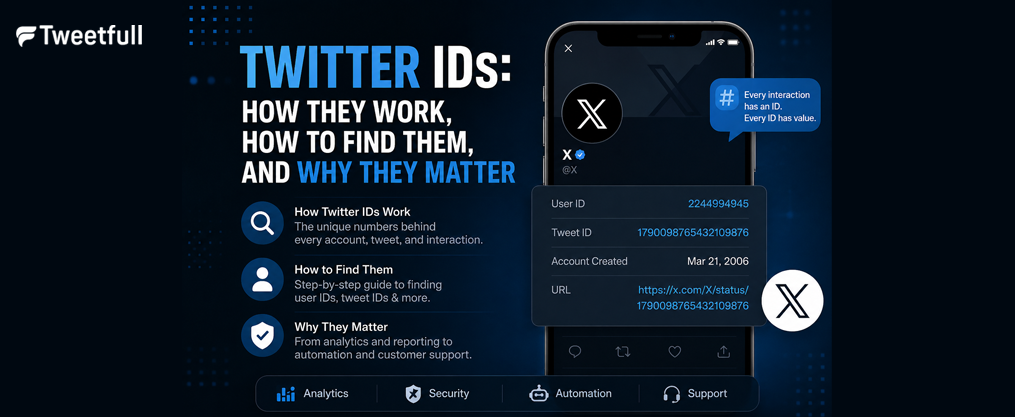
A Twitter ID is a permanent internal identifier-a unique id assigned by X Corp when an account is created. It never changes, even if the twitter username, display name, or profile picture is updated later. Jack Dorsey’s account, for example, has the numerical user id 12, while a modern tweet id like 1767355829412341760 appears in the tweet url after /status/. Even if you rebrand with a new Twitter username or handle, that underlying id stays the same.

Unlike twitter handles, user ids are what X’s backend uses to associate followers, tweets, and direct messages with the same account. Tweets and other objects also have unique ids assigned by X, implemented as Snowflake numbers-64-bit integers with an embedded timestamp, datacenter id, machine id, and sequence number. This makes every id globally unique and ensures smaller numbers correspond to older accounts or tweets, which is helpful when ordering engagement data for individual Twitter posts.
Inside the Twitter ID Format and How It’s Generated
Modern twitter ids are generated by the Snowflake system introduced around 2010. A Snowflake packs a millisecond-precision timestamp (since a custom epoch of November 4, 2010), a datacenter identifier, a server worker id, and a per-millisecond sequence into 64 bits. A large numerical id like 1479096491212457984 embeds enough data that a decoder tool can extract the approximate date the twitter user signed up. Older twitter accounts have shorter user ids than newer ones simply because the timestamp component was closer to the epoch at that moment.
String vs Integer Representation of Twitter IDs
JavaScript only supports safe integers up to 2^53−1, but many twitter ids exceed this limit. Treating a userid like 1767355829412341760 as a Number in a script or app will silently round it, breaking equality checks and api calls. The twitter api-and the x api v2 by default-returns ids as strings in json payloads for exactly this reason. Developers writing in programming languages without native 64-bit integer support (including front-end code on any platform, whether Apple Safari or Chrome) must always handle ids as strings.
Storing and Comparing User IDs Safely
Store each twitter user id and tweet id as VARCHAR/TEXT or BIGINT depending on your stack, preserving full 64-bit precision. Avoid converting ids to floating-point in software like Google Sheets or BI tools-that process can mangle large values. Because ids are roughly time-ordered, sorting them numerically will sort objects by creation date, which is critical for analytics. Consistent string types at every api boundary prevent subtle bugs when you search, retrieve, or compare ids across services.
How to Find a Twitter User ID or Tweet ID
X’s screen shows @usernames, not raw ids, so finding them requires a few tricks.
Quick Methods: URLs and On-Page Clues
For a tweet id, check the status url (e.g., https://x.com/username/status/1767355829412341760) and copy the number after /status/. For user ids, the intent url https://twitter.com/intent/user?user_id=12 resolves to the corresponding profile. You can also find a user’s id by using their profile url: open the page source code while logged in, search for “user_id” or “id_str”, and copy the numerical id. This works for any active public twitter user and is especially useful when archiving ids for multi-tweet Twitter threads.
Using APIs and Tools for ID Lookup
The official X API v2 endpoint /2/users/by/username/:username is the most robust lookup method. After authentication with api keys, send a GET request with the username as input and parse the id field from the json response. Third-party id lookup tools and finder services-like TwXPicker-let you convert a handle or profile url into a numerical user id instantly, often returning extra metadata such as follower count, avatar, bio, and joined date. Many support bulk lookup, outputting CSV or json. Always respect X’s rate limits and verification policies; never enter your password on untrusted site services.

Practical Uses of Twitter User IDs and Tweet IDs
Stable numerical ids underpin data analysis, moderation, marketing, and security workflows across the platform.
Giveaways, Contests, and Community Audits
Running contests fairly requires tying entries to a unique twitter user id rather than a mutable @username or display name, especially when prizes or monetization strategies on X are involved. The twitter user id is essential for verification in contests-collect participants, deduplicate by user id, and maintain an audit trail. This reference point stays valid even if winners change their username, profile picture, or Twitter profile background design after the contest. Repeated user ids across datasets reveal bots or users entering from multiple accounts.
Analytics, Data Pipelines, and Research
Analysts use user ids and tweet ids as primary keys in data warehouses to measure engagement over time and to understand who engages with their account most. Usernames are less reliable for tracking than user ids. When merging CRM records, follower exports, or ad platform exports with X data, the numerical user id is the safest join key for any follower list management workflow. Keep ids as unaltered strings in CSV, json, or Excel exports. Researchers also use tweet ids to reconstruct conversation threads and study username-changing behavior across the platform.
Security, Compliance, and Handling Deleted Accounts
Security teams track abuse by user id, catching repeat offenders even when they rotate twitter handles. Moderation logs and law-enforcement requests typically reference user ids and tweet ids for unambiguous identification. Teams also monitor unfollowers and follower churn patterns by tracking user ids over time. For deleted accounts, public endpoints may no longer return data, but cached pages or web archives sometimes still contain the numeric id in the source code. Retaining user ids in event logs helps organizations meet compliance requirements without storing unnecessary personal data.
FAQ
Below are common questions about twitter id lookup, deleted accounts, and the difference between ids and usernames.
Is a Twitter user ID the same thing as a tweet ID?
No. A twitter user id identifies an account, while a tweet id identifies a single post. Both are 64-bit Snowflake numbers but refer to different object types. In api responses, look for user.id versus data.id for tweets. Tools built for user id lookup will not return tweet ids unless explicitly designed for both.
Can I find the Twitter user ID of a deleted or suspended account?
If an account is fully deleted, current public endpoints typically will not return its user id. Older cached pages on Google or the Wayback Machine may still contain the numeric id. Unless you stored the id before deletion, recovery is difficult. For legal cases, X Corp’s internal systems can still resolve ids, but this access is unavailable via public APIs.
Does changing my @username or profile picture change my Twitter user ID?
No. Your twitter user id remains the same from the moment the account is created onward-user ids are permanent and do not change with usernames. External tools and integrations keep working even after you rebrand. To get a new user id, you would need to create an entirely new account.
Why do some Twitter IDs look so small (like 12) while others are 18+ digits long?
Early accounts from 2006–2007 received small sequential ids. After the Snowflake system launched, newer accounts received long 18–19 digit ids. The size difference has no effect on functionality and the system treats all ids identically. A finder or decoder tool can extract the embedded creation timestamp from any Snowflake id for precise dating, which can be interesting context when you create a new Twitter account and compare its age to others.
Is it safe to share my Twitter user ID with other services?
A twitter user id is derived from your public profile and is generally no more sensitive than your @username. Sharing it with reputable services is typically safe, but avoid entering login credentials on untrusted id lookup, analytics, or direct message management sites-legitimate tools should never require your password. Combining user ids with other personal data increases privacy risk, so organizations should minimize unnecessary data collection through keywords like emails or payment details in the same context.