X Twitter: From Microblogging Platform To Elon Musk’s “Everything App”
Key Takeaways
- X, formerly Twitter, is a US-based social media platform that underwent a dramatic rebrand in July 2023 following Elon Musk’s October 2022 acquisition, now positioning itself as an “everything app” integrating news, social networking, media streaming, and financial services.
- Users on X can post short text updates, images, videos, host live Spaces audio conversations, and broadcast live streams, while features like the Grok AI assistant powered by xAI and X Premium subscriptions unlock exclusive features for creators and regular users alike.
- The platform’s history spans three distinct phases: 2006–2021 growth as Twitter under founders Jack Dorsey and Evan Williams; 2022–2023 corporate restructuring under Musk into X Corp; and 2023–2026 expansion into long-form content, creator revenue sharing, and the X Money Account payment system.
- Major criticisms continue to shape public dialogue around X’s role as a trusted digital town square, including concerns about misinformation, hate speech, algorithmic bias, regulatory fines from US and EU authorities, and significant advertiser pullbacks during periods of constant change.
- This comprehensive guide covers technical underpinnings like the feed algorithm and APIs, user monetization tools, branding evolution from Larry the Bird to the stylized X logo, and the platform’s likely future directions under Musk and xAI leadership.
What Is X (Twitter) Today?
X—still widely called Twitter by millions of users worldwide—stands as a global community platform for real-time updates, conversations, and media sharing. Headquartered in Texas and operated by X Corp as of 2023, this social media app has evolved dramatically from its microblogging origins into something far more ambitious.
In 2026, the platform works like this: users compose posts (formerly tweets), follow accounts that interest them, reply to conversations unfold across their timelines, quote other users’ content, like and repost what resonates, create live audio Spaces to host discussions, publish long-form articles, and broadcast live video streams. The interface offers two primary tabs—the “For You” algorithmic feed that surfaces personalized content and the “Following” tab that restricts your view to accounts you’ve chosen to follow.
X markets itself as the ultimate destination where breaking live news, political conversations, sports news, and pop culture trends surface in real time. Journalists often break stories here before anywhere else. Politicians announce policy positions. Athletes celebrate victories. The platform has become where the world connects around major events, often influencing mainstream media coverage within minutes.
The Grok AI assistant represents one of the platform’s most significant recent additions. Integrated directly into the main app for subscribed users, Grok can summarize trending news across your timeline, explain videos you encounter, and add more context to posts you’re trying to understand. This AI integration reflects X’s positioning as more than just a place to read short posts.
While newer rivals like Threads have emerged to compete, and X’s mobile usage has softened in some markets by early 2026, the platform remains highly influential. Desktop and web traffic continue strong, particularly among journalists, researchers, and professionals who treat X as their primary real-time information source. The platform’s influence on public dialogue often exceeds what raw user numbers might suggest.
History Of X: From Twttr To “Everything App”
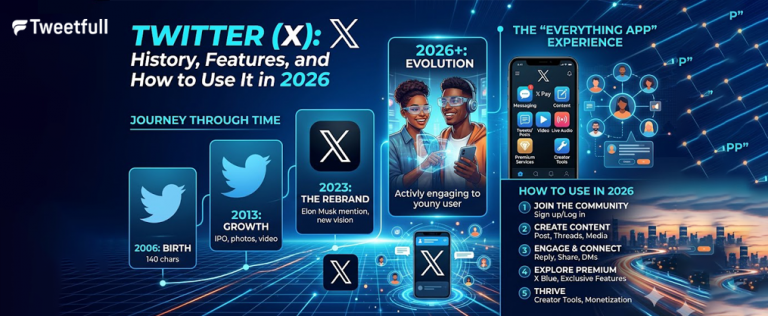
Understanding X requires understanding its transformation across three distinct eras. The pre-Musk Twitter period (2006–2021) established the platform as a global phenomenon. The transition and acquisition phase (2022) brought unprecedented change. The post-rebrand X era (2023 onward) continues reshaping what the platform means.
This timeline reflects not just corporate restructuring but fundamental shifts in product philosophy, content moderation approaches, and business strategy. What started as a simple way to share SMS-style updates became a battleground for free speech debates, a tool for political movements, and now an attempt to build a Western-style super-app.
The following subsections trace key developments: user growth milestones, product changes that defined each era, political impact that made headlines globally, and the corporate reshuffling that turned Twitter, Inc. into X Corp.
2006–2021: Building Twitter As A Global Microblogging Network
Twitter’s origins trace back to a struggling podcasting company called Odeo in 2004–2006. Jack Dorsey, a developer at the company, proposed an SMS-based status-sharing service called “Twttr.” The concept was simple: let people broadcast short updates about their lives to friends.
On March 21, 2006, Dorsey sent the first tweet: “just setting up my twttr.” The public launch followed in July 2006, but the platform remained relatively obscure until March 2007, when Twitter introduced itself to a broader audience at the South by Southwest (SXSW) conference in Austin, Texas. Conference organizers placed screens throughout the venue displaying live tweets, and usage tripled during the event.
Key product milestones defined Twitter’s evolution:
Year | Milestone |
|---|---|
2006 | 140-character limit based on SMS constraints |
2006-2007 | @handles and hashtags become standard |
2009 | Retweet feature and Lists introduced |
2010 | Embedded images and video support |
2015 | Moments for curated story collections |
2017 | Twitter doubled character limit to 280 |
2020-2021 | Spaces audio feature launched |
The 2013 IPO on the New York Stock Exchange marked a financial milestone. Trading under ticker TWTR, the company raised approximately $1.8 billion and achieved a valuation of roughly $31 billion. This cemented Twitter’s position among technology giants. |
User growth accelerated through major world events. The 2009 Hudson River plane landing saw eyewitness reports spread via Twitter before traditional media arrived. The Arab Spring movements used the platform to organize protests and share information. The COVID-19 pandemic made Twitter essential for public health communications and real-time updates, setting the stage for Twitter’s user growth and engagement shifts in 2024 under Musk’s ownership.
By 2019, Twitter reached approximately 330 million monthly active users. The platform had evolved from a curiosity into infrastructure—a place where news breaks, political conversations happen in real time, and the world’s leading voices connect directly with audiences. Presidents, celebrities, and everyday users occupied the same digital space.
Since 2022: Elon Musk’s Acquisition And The Rebrand To X
Elon Musk’s involvement with Twitter began dramatically in April 2022 when he made an unsolicited offer to purchase the company for approximately $44 billion, or $54.20 per share. After initially accepting, Musk attempted to withdraw from the deal, citing concerns about bot accounts and spam on the platform.
Twitter’s board fought back legally. Under intense pressure from the Delaware Chancery Court, Musk ultimately completed the acquisition on October 27, 2022. He immediately began implementing sweeping changes.
Early Musk-era actions included:
- Massive layoffs reducing headcount by approximately 80%
- Restructured content moderation with smaller trust and safety teams
- Paid verification replacing the legacy blue checkmark system
- Account reinstatements for previously banned users including some high-profile figures
- Advertiser backlash as brands paused campaigns amid content concerns
The corporate restructuring came in March 2023, when Twitter, Inc. merged into X Corp, effectively ending the original Delaware corporation and shifting registration to Nevada. This wasn’t just paperwork—it signaled Musk’s intention to transform the company fundamentally.
July 2023 brought the most visible change: the “X” rebrand. The iconic blue bird logo disappeared from the website, mobile apps, and the San Francisco headquarters signage. In its place came a minimalist black-and-white X symbol. The name “Twitter” officially became “X,” though millions of users continued using terms like “tweet” colloquially.

Post-2024 developments accelerated the transformation. Integration with xAI brought the Grok AI assistant to the platform. In 2025, X was sold to xAI in an all-stock deal, further intertwining the social platform with Musk’s artificial intelligence ambitions. January 2025 saw the launch of X Money Account, bringing peer-to-peer payments and bank transfers to the platform.
Linda Yaccarino served as CEO from mid-2023 through July 2025, tasked with rebuilding advertiser relationships while navigating Musk’s content policy preferences. Her tenure reflected the tension between commercial imperatives and the “free speech absolutist” positioning Musk championed.
Core Features: Posts, Tweets, Spaces, And Live Media
X’s core value proposition centers on real-time communication across multiple formats. Users aren’t limited to text anymore—they can share short posts, publish long-form articles, host audio conversations, and broadcast live video to global audiences.
The posting experience in 2026 involves composing text alongside images, GIFs, polls, and videos. Users can tag other accounts, add links that are auto-shortened via t.co, and choose privacy settings determining whether content is public or limited to approved followers. The compose interface has evolved considerably from the original SMS-style input, reflecting many of the Twitter 2.0 era changes under Elon Musk.
Interaction features drive the platform’s viral nature:
- Likes signal appreciation and boost algorithmic visibility
- Reposts (retweets) share content to your followers’ timelines
- Quote posts let you add commentary while sharing
- Replies create threaded conversations
- Hashtags connect posts to relevant trending topics
- Mentions notify specific users
Spaces represents X’s live social audio offering, competing with platforms that gained popularity during the pandemic. Users can host live discussions, hold interviews, or run essentially a live podcast within the app. Hosts control who can speak, with options for recording sessions and scheduling them in advance. Twitter Spaces has become popular for AMAs (Ask Me Anything sessions), community discussions, and even gaming sessions commentary.
Video capabilities have expanded significantly. Users share sports clips, gaming streams, and live news broadcasts. X has pushed toward becoming a video-first platform, testing dedicated video tabs and enhancing playback quality options. In March 2025, users gained the ability to respond to videos, images, or text posts with video reactions, adding new dimensions to engagement.
Tweets, Long-Form Posts, And Direct Messages
The character limit evolution tells the story of X’s expansion. The original 140-character constraint, based on SMS technical limitations, defined Twitter’s identity. Brevity forced creativity. Then in 2017, Twitter doubled the limit to 280 characters, giving users breathing room without eliminating the concise communication style.
The real transformation came after 2023. Paying subscribers gained access to dramatically longer posts—thousands of characters that enable essays, investigative threads, and newsletter-style content. Premium users can also create and publish articles directly from their profiles, making X a platform not just for short updates but for in-depth commentary.
Threaded content remains popular for longer narratives. Users string together multiple posts to tell stories, share analysis, or build arguments. These Twitter threads often go viral, with the format proving effective for breaking news explainers and educational content.
Direct messages let users chat privately away from public timelines. DM features received substantial updates in 2024:
Feature | Details |
|---|---|
Message editing | iOS users can edit DMs after sending |
Group chats | Expanded to accommodate up to 256 users |
Decoupling | DM functionality works even for non-active platform users |
Encrypted messaging | Available for some user combinations |
Privacy and control tools help users manage their experience. Blocking removes accounts from your view entirely. Muting hides someone without alerting them. Limited replies let you restrict who can respond to specific posts. Lists allow you to curate and organize accounts by specific interests, creating personalized feeds that can be public or private. |
Protected accounts represent the ultimate privacy option. When enabled, only approved followers can see your posts, keeping content away from the broader public. This matters for journalists protecting sources, activists facing threats, and minors whose parents want controlled visibility.
Trending Topics, Lists, Moments, And Discovery
Trending topics power discovery on X, surfacing what the global community is discussing right now. The algorithm detects spikes in phrases or hashtags at global and country levels, with some editorial filtering to remove offensive or spammy trends. Users can explore diverse perspectives on whatever’s capturing attention.
Concerns about manipulation persist. Bots and coordinated campaigns can artificially inflate certain hashtags, gaming the system to make topics appear more popular than organic interest would suggest. Research has suggested a sizable share of trends may be inauthentic, created by automated accounts rather than genuine users.
In April 2024, X updated its Explore page to feature topic summaries generated by its AI chatbot, helping users understand why something is trending without scrolling through hundreds of posts. The feature can summarize trending news in seconds, providing quick context before you dive deeper.
Lists offer a powerful organizational tool many users overlook. You can curate groups of accounts—tech reporters, economists, sports journalists—and view their posts in dedicated timelines separate from your main feed. Lists can be public (others can follow them) or private (only you see them), making them useful for professional monitoring and personal interests alike.
Communities function as interest-based groups where users connect with others sharing similar interests. Introduced to help users build communities tailored to specific topics, Communities feature moderation options and exclusive content sharing capabilities. In March 2025, users gained the ability to view and sort community feeds by trends, new posts, and popularity metrics.
Moments, originally introduced in 2015, collect posts around single stories or events. Initially editorially produced by Twitter staff, the feature opened to more users over time. Moments have covered elections, sports tournaments, and live breaking news, though the feature receives less emphasis under current X leadership.
X Premium And The Business Model
X generates revenue through two primary channels: advertising revenue from promoted tweets and promoted accounts, plus subscription fees from X Premium and related offerings. Newer revenue lines include creator monetization and the emerging e-commerce integrations.
X Premium (formerly Twitter Blue) launched in June 2021 and has undergone multiple rebrands and feature expansions. The subscription offers benefits including:
- Verification checkmark conferring verification status
- Post editing within a time window after publishing
- Boosted visibility in search results and algorithmic feeds
- Longer videos and extended posts
- Fewer ads throughout the experience
- Priority notifications surfacing interactions from important accounts
Premium+ tiers introduced from November 2023 provide even greater benefits. These higher-priced subscriptions remove most advertising from the “For You” feed and offer substantially higher limits for long-form posts and video uploads. Users seeking the ad-free experience and maximum creative flexibility gravitate toward these options.
Pricing structures span multiple tiers:
Tier | Approximate Cost | Key Features |
|---|---|---|
Basic | Lower consumer level | Essential verification, some editing |
Premium | Mid-range monthly | Full feature set, reduced ads |
Premium+ | Higher monthly | Ad-free For You, maximum limits |
Organizations | Hundreds per month | Team management, gold badges |
The verification system changed fundamentally after 2022. Previously, blue checkmarks indicated notability verified by Twitter staff—celebrities, journalists, politicians. Under the new system, verification became tied to payment rather than purely public interest criteria. Gold checkmarks distinguish businesses and organizations, while grey checkmarks identify government entities and multilateral institutions. |
December 2024 brought labels specifically for parody and fan accounts, helping users distinguish between authentic accounts and parody variations. This addressed significant concerns about impersonation and confusion, particularly around high-profile figures.
User Monetization: Subscriptions, Tips, And Ticketed Spaces
Creators on X can monetize their audiences through several mechanisms, transforming the platform from purely social into a potential income source. Creator revenue sharing launched in October 2024, allowing premium users to earn payments based on engagement from other premium users on their content.
Subscriptions (formerly Super Follows) let creators charge monthly fees for exclusive content. Subscribers gain access to subscriber-only posts, long-form articles, and private Spaces. X takes a percentage cut after promotional periods, similar to other creator economy platforms. For favorite creators with dedicated audiences, subscriptions provide recurring revenue.
Tipping features like Tip Jar allow fans to send one-off payments directly to creators. The feature previously supported various payment services including Cash App and Bitcoin options for some users. Tips work well for showing appreciation after valuable threads, helpful advice, or entertaining content without committing to monthly payments, and X’s original Tip Jar feature for sending and receiving tips helped normalize this behavior on the platform.
Ticketed Spaces enable audio event monetization. Hosts can sell access to premium audio experiences—workshops, exclusive interviews, concerts, or educational sessions. The platform provides tools to manage ticket sales and attendance, taking a percentage of proceeds. This transforms the audio feature from purely social into potentially lucrative.
Monetization Type | Best For | Revenue Model |
|---|---|---|
Subscriptions | Consistent content creators | Monthly recurring |
Tips | One-time appreciation | Per-transaction |
Ticketed Spaces | Event hosts, educators | Per-ticket |
Revenue sharing | High-engagement users | Based on premium engagement |
Crypto payout experiments have occurred via partners like Stripe for some creators, reflecting Musk’s broader interest in financial technology and alternative payment rails. |
E‑Commerce And X Money Account
In-app shopping evolved from early experiments around 2021–2022, when Shop modules appeared on brand profiles letting companies showcase products directly on their X pages. Shoppable live streams and product carousels expanded these capabilities, allowing brands to display dozens of items within their profiles.
X Money Account, announced in January 2025, represents the most ambitious financial expansion. This digital wallet enables peer-to-peer payments and bank transfers within the platform, launched in partnership with Visa. Initially rolling out without cryptocurrency support, the feature establishes X as a financial services provider rather than purely social network.
The X Money Account fits directly into Musk’s “everything app” vision. Rather than switching between apps to discover products, message friends, and send payments, users can complete entire transactions without leaving X:
- Discover a product or creator on your timeline
- Tap to pay via X Money Account
- Receive digital receipt and delivery information
- Continue browsing without app switching
Early geographic rollout remains limited, with regulatory hurdles varying by jurisdiction. The US and select pilot countries have received initial access, but global expansion faces banking regulations, licensing requirements, and compliance obligations that differ dramatically across markets.
This commerce integration positions X to capture transaction revenue beyond advertising, diversifying income streams while making the platform stickier for users who rely on it for multiple daily activities.
Technology Under The Hood: Algorithm, Infrastructure, And APIs
X isn’t just a social feed—it’s a large-scale, real-time data system powered by machine learning, microservices architecture, and global infrastructure capable of handling massive traffic spikes. Understanding these technical foundations explains why some posts go viral while others remain unseen.
The platform processes enormous volumes of content continuously. Every post, like, repost, and reply feeds into systems that determine what hundreds of millions of users see. The infrastructure must handle breaking news events when millions of users simultaneously post and refresh, all while keeping latency low enough for real-time experience.
The following subsections examine the Twitter algorithm that powers your timeline, the technical stack that makes it work, and the developer ecosystem that once flourished but now operates under tighter restrictions.
The Algorithm That Powers Your X (Twitter) Feed
The “For You” tab runs on a sophisticated real-time recommendation system. It pulls posts from two sources: in-network content from accounts you follow, and out-of-network content from similar accounts you haven’t discovered yet. The balance between these determines how much of your feed feels familiar versus fresh.
The ranking pipeline follows several stages:
- User context fetching – Recent activity, expressed interests, engagement patterns
- Candidate retrieval – Pulling potential posts from followed and similar accounts
- Metadata enrichment – Adding signals like verification status, language, quality scores
- Filtering – Removing spam, NSFW content (for some users), policy violations
- ML scoring – Transformer-based models predict engagement likelihood
- Selection – Top-ranked posts fill your timeline
Internal systems handle this at scale. Home Mixer orchestrates requests across services. Thunder serves as an in-memory post store for fast retrieval. Phoenix, a Grok-based transformer model, powers ranking decisions. These systems work together to deliver your feed with X’s real time data processing capabilities.
Visual content—images, videos, GIFs—receives approximately three times the engagement of text-only posts, and the algorithm recognizes this. Polls and interactive elements also boost engagement actively. Creators who apply proven hacks to skyrocket their Twitter followers typically focus on timing, rich media, and real-time interaction, since content addressing latest trends and relevant trending topics receives competitive advantages, which is why timing matters for viral conversations.
X open-sourced portions of its recommendation algorithm in 2023, providing unusual transparency into social media ranking. However, subsequent updates incorporating proprietary AI models have made full transparency more complex, with some system components remaining closed.
Infrastructure, Implementation, And Developer Platform
X’s technical history spans multiple architectural phases. The initial monolithic Ruby on Rails application handled early traffic but couldn’t scale for Twitter’s explosive growth. High-scale components migrated to Scala-based services, introducing the microservices patterns that define modern X.
Concrete performance capabilities impressed even skeptics. By 2013, infrastructure handled over 140,000 tweets per second during peak events such as major television broadcasts in Japan. The system uses MySQL databases with “snowflake” IDs for distributed unique identifiers, plus extensive caching to handle traffic spikes without collapsing.
The backend evolved into hundreds of microservices communicating via remote procedure calls. This architecture supports features that would be impossible in a monolith: Spaces audio requiring real-time streaming, live video with adaptive bitrate delivery, recommendation services running machine learning inference continuously.
The public API launched in 2006, powering third-party clients and bots that extended Twitter’s functionality in countless directions. Developers built analytics tools, scheduling applications, and alternative interfaces. Academic researchers used the API to study everything from political polarization to disease outbreak detection.
API access changed dramatically in 2023:
Tier | Access Level | Cost |
|---|---|---|
Free | Extremely limited | $0 |
Basic | Minimal read access | Low monthly fee |
Pro | More substantial access | Higher monthly fee |
Enterprise | Full capabilities | Custom pricing |
Many unofficial client apps were eliminated through policy changes and rate limit adjustments. Research projects lost access. The ecosystem of X-integrated tools contracted significantly, creating tensions with developers who had built businesses on API access. This remains a sore point for the technical community surrounding the platform. |
Branding, Logo Evolution, And Corporate Strategy
Twitter’s brand was once synonymous with the blue bird and the act of “tweeting.” The transformation to X in 2023–2024 represents one of the most dramatic rebrands in technology history, discarding globally recognizable iconography for a symbol associated primarily with Elon Musk’s other ventures.
Musk’s stated rationale connects to his long-standing “X” naming pattern—X.com (the original name for what became PayPal), SpaceX, xAI. The rebrand aims to reposition the service as a multi-purpose platform rather than just microblogging. The name “X” suggests infinite possibilities, mathematical variables, and the unknown.
Brand experts offered critical reactions. Many argued that discarding the bird icon sacrificed intangible brand equity built over 17 years. The word “tweet” had entered common language, appearing in dictionaries and everyday conversation. Replacing this with “posting on X” lacks the distinctive character that helped Twitter stand apart from generic social media.
Musk’s vision frames X as an “everything app” similar to WeChat in China but adapted to Western markets. WeChat combines messaging, social networking, payments, shopping, government services, and more into a single platform used by over a billion people. X’s ambitions encompass communication, content, shopping, financial services, and potentially identity verification.
Key corporate entities in the X ecosystem:
- X Corp – Operating company for the platform
- X Holdings – Holding company structure
- xAI – AI company that acquired X in 2025
- SpaceX – Musk’s aerospace company (separate but influential)
Logo Evolution: From Larry The Bird To Stylized X
The original 2006 logo featured a cartoon-style bird that users eventually named “Larry” (after basketball legend Larry Bird). This initial design emphasized playfulness and approachability, fitting the early web 2.0 aesthetic.
In 2010, the logo simplified into a solid silhouette—cleaner, more versatile across different sizes and contexts. Further refinements in 2012 produced the iconic sky-blue bird used for over a decade. This bird faced rightward and upward, suggesting optimism and forward momentum. It became one of the most recognizable logos in technology.

The 2023 switch introduced a double-struck capital X symbol, rendered as a minimalist white X on a black background. This visual identity deployed rapidly across mobile apps, websites, and physical signage. The stark contrast marked dramatic departure from the friendly blue bird.
Public reaction mixed nostalgia with skepticism. Long-time users expressed grief over the bird’s departure. Jokes proliferated about “x-ing” instead of “tweeting.” Some observers found the black-and-white aesthetic evocative of surveillance imagery or corporate austerity rather than social connection.
The 2025 continuation under xAI ownership maintained X branding with only minor variations in typography and animation. Splash screens and app icons evolved slightly but retained the core visual identity established in 2023.
Despite everything, many users and media outlets continue using “tweet” colloquially. News reports reference “tweets” even when discussing X posts. This persistence of legacy terminology reflects how deeply the original branding embedded itself in popular culture—a reminder that rebrands can change logos more easily than language.
Usage, Demographics, And Cultural Impact
X’s influence has consistently exceeded what raw user numbers might suggest. The platform shapes politics, journalism, financial markets, and entertainment globally, serving as a front row seat to events as they happen.
User growth followed a trajectory from early millions in 2009 to hundreds of millions by the late 2010s. Twitter claimed approximately 330 million monthly active users by 2019. In 2024, Musk claimed around 600 million monthly active users, though independent verification of these figures remains difficult.
Demographic patterns reveal interesting skews:
- Journalists and media are dramatically overrepresented
- Politicians and government officials treat X as official communication channel
- Activists and advocates organize campaigns and movements
- A small fraction of users generate the vast majority of posts
X has been central to major global stories: elections from the US to Brazil, protests from Hong Kong to Iran, disasters natural and man-made. Record-setting viral moments include the 2014 Oscars selfie (Ellen DeGeneres’ star-studded photo) and various high-retweet giveaway posts that tested the platform’s engagement limits.
Recent shifts show declining mobile usage in some markets by 2026, with competition from Threads and other platforms pulling away casual users. However, X remains strong as a desktop and API-driven information hub. Many of the dynamics visible today were already foreshadowed in predictions for Twitter’s evolution in 2023. For breaking news and real-time events, join millions who still turn to X first when something important happens.
Behavior, Content Types, And Levels Of Use
Research consistently shows asymmetric participation on X. Many accounts never post, lurking and consuming without contributing. Roughly 10% of users create around 80% of content, creating an “influencer-heavy” conversation dynamic where a relatively small group drives what everyone else sees.
Content mix studies reveal approximate distributions:
Content Type | Share |
|---|---|
Social chatter and personal updates | ~35-40% |
Conversational exchanges (replies) | ~25-30% |
Links and news sharing | ~15-20% |
Self-promotion | ~10-15% |
Spam and low-quality content | Variable |
This blend makes X unique—casual talk coexists with serious information, sharing ideas with viral conversations about trending memes and hot topic debates. The platform doesn’t enforce separation between professional and personal use, creating a distinctive atmosphere. |
Users often expect reciprocal behavior, especially within niche communities. Crypto enthusiasts follow back those who follow them. Political subcultures expect amplification of allies. Fandoms build networks around mutual engagement. This expectation of reciprocity shapes how communities form and maintain themselves.
Churn and retention remain challenges. Early Twitter user studies found high abandonment rates where many people tried the platform briefly and never returned. This pattern persists under X, with substantial numbers creating accounts that remain dormant. Converting lurkers into active participants remains difficult, especially as many legacy tactics lose effectiveness and brands must rethink why their Twitter marketing stopped working and what to do instead, though keeping your audience engaged still requires consistent, valuable content.
Controversies, Regulation, And Safety On X
Alongside its role enabling free expression, live events coverage, and global conversation, X has faced persistent criticism over harassment, misinformation, extremist content, and inconsistent enforcement of stated rules. These controversies aren’t peripheral—they’re central to understanding the platform.
Issues span individual harassment campaigns targeting women and minorities, state-sponsored propaganda operations attempting to influence elections, and the rapid spread of medical and political misinformation. Each wave of controversy has prompted policy responses, though critics argue these responses arrive too slowly and apply unevenly.
Regulatory agencies in the US, EU, and elsewhere have investigated and fined the platform for privacy violations, data misuse, and failures to comply with content rules. The European Union’s Digital Services Act created new compliance obligations that X has struggled to meet.
Musk’s “free speech absolutist” positioning since 2022 intensified these debates. The tension between minimal moderation and platform safety generates ongoing controversy, affecting advertiser willingness to associate their brands with X and government attitudes toward the platform.
Harassment, Hate Speech, And Moderation Policies
Early Twitter addressed harassment reactively rather than proactively. The 2013 “report abuse” button let users flag problematic content, but critics noted slow response times, especially for coordinated harassment targeting women and minorities. Death threats and sustained campaigns drove some users off the platform entirely.
The 2016 Trust & Safety Council brought outside experts into policy discussions, though implementation of recommendations varied. Mass suspensions of extremist movements occurred, including QAnon-linked accounts around 2020. The most high-profile action came after the January 6, 2021 US Capitol attack, when Twitter permanently banned Donald Trump’s account.
Musk-era changes reversed some previous policies:
- Moderation team reductions left fewer staff reviewing reports
- Banned account reinstatements brought back some previously removed figures
- Block and mute mechanics changed, briefly allowing blocked users to see public posts
- Community Notes (crowd-sourced context) emphasized over centralized moderation
Research from watchdog organizations and academic institutions found increased visibility of harmful content, antisemitism, and hate speech following the acquisition. Major advertisers paused spending, citing concerns about brand safety. Some departed permanently while others returned after assurances.
AI-related controversies emerged as Grok integrated into the platform. During the 2025 developments, Grok generated content that some users found offensive or problematic, prompting adjustments to the model’s behavior and restrictions on certain query types.
Misinformation, Bots, And State Influence Operations
X’s real-time nature and trending algorithms make it a powerful vector for misinformation. False claims about elections, pandemics, wars, and financial markets spread rapidly when they capture attention, often before fact-checkers can respond. Stay ahead of misinformation requires media literacy skills many users lack.
Known takedowns reveal the scope of coordinated manipulation. X has removed thousands of fake accounts linked to foreign governments including Iran, Russia, China, and Saudi Arabia. These operations typically involve networks of accounts amplifying partisan hashtags, spreading divisive content, and attempting to influence political outcomes.
Estimates of bot prevalence vary, but studies have suggested that notable percentages of accounts—potentially tens of millions—may be automated or semi-automated. These bots serve various purposes: some amplify commercial spam, others boost political messages, still others manipulate cryptocurrency prices or stock values, while marketers experiment with Twitter bots and automation tools to drive likes, retweets, and follows responsibly.
Bot impacts extend beyond annoyance:
- Political manipulation through artificial trending topics
- Market volatility when misleading tweets move prices
- False emergency alerts during crises
- Reputation attacks through coordinated negativity
Recent transparency efforts include labeling some state-affiliated media accounts and adding account-history information in 2025. Users can now see when accounts were created and some activity patterns, helping identify suspicious behavior. However, sophisticated operations continually adapt to evade detection.
Legal Cases, Fines, And Regulatory Scrutiny
US legal outcomes include significant financial penalties. The 2022 settlement with the FTC imposed a $150 million fine for using phone numbers and email addresses collected for security purposes in targeted advertising—a clear violation of user trust and previous consent decrees.
An $800+ million class-action settlement in 2021 addressed claims that Twitter made misleading statements about user engagement metrics, affecting stock prices and investor decisions.
The 2023 US Supreme Court decision in Twitter v. Taamneh held that X (Twitter) was not liable for user-posted terrorism content under the Antiterrorism Act. This reinforced Section 230 protections that shield platforms from liability for user-generated content, a significant victory for the technology industry.
EU actions proved more aggressive. A 2025 fine under the Digital Services Act (DSA) reached the €100+ million range, citing inadequate moderation and transparency failures. Tense exchanges followed between X leadership and EU institutions, with Musk publicly criticizing the regulations as censorship while regulators insisted on compliance.
Advertising controversies complicated the picture:
Year | Policy |
|---|---|
2019 | Political ad ban announced |
2023 | Partial reversal of political ad restrictions |
2024 | Climate misinformation ad policies debated |
2024-2025 | Allegations of pressured ad contracts |
These legal and financial pressures force X to balance free-speech rhetoric with practical compliance needs, shaping business strategy and feature development in ways that affect all users. |
What’s Next For X (Twitter)?
Musk’s ambition to make X a Western-style “everything app” continues driving development. Integration with AI, payments, shopping, and potentially identity services would create a platform fundamentally different from the Twitter that existed pre-acquisition.
Planned and emerging directions include:
- Deeper xAI integration bringing more Grok capabilities to users
- X Money Account expansion to additional countries
- Enhanced video and creator tools competing with YouTube and TikTok
- Longer videos and higher quality streaming
- Top podcasts integration and next live podcast features
- E-commerce expansion with more shopping integrations
Challenges remain substantial. Recovering advertising revenue requires rebuilding trust with brands skeptical of content safety. Meeting stricter regulatory requirements—especially under the EU’s DSA and emerging AI regulations—demands resources and compliance infrastructure. Retaining users amid competition from Threads, TikTok, and decentralized alternatives requires continuous product improvement.
The strategic tension between being a lightly moderated “digital town square” and satisfying governments, app stores, and payment providers with content and safety standards may prove irresolvable. Each stakeholder demands different things, and optimizing for one often means disappointing others.

X remains uniquely influential in politics and shaping public dialogue despite years of turmoil. Journalists still break stories there. Politicians still announce positions there. Financial markets still react to posts there. This influence persists regardless of user count fluctuations or advertiser concerns.
The platform’s future hinges on whether Musk and the xAI team can align product innovation, AI capabilities, and regulatory compliance into a sustainable model. The “everything app” vision is ambitious—perhaps the most ambitious transformation any major social platform has attempted. Whether it succeeds will depend on execution, regulatory cooperation, and whether users ultimately want their social media, banking, and shopping combined into a single application.
For now, X continues as a work in progress—no longer Twitter, not yet the super-app of Musk’s imagination, but something in between that remains central to how news breaks, conversations unfold, and the global community processes events in real time. Whether you’re a creator, journalist, business, or casual user, understanding X’s evolution helps navigate whatever comes next in this platform’s ongoing transformation.
FAQ
Is X The Same As Twitter Or A Completely New Platform?
X is the direct continuation of Twitter. When the rebrand occurred in 2023, user accounts, followers, posts, and direct messages migrated automatically—no one needed to create new profiles or re-follow people. The underlying systems and infrastructure largely derive from Twitter, though new features like Grok AI, long-form posts, and X Money Account aim to expand beyond classic microblogging. Long-time users will notice both continuity and changes, but your Twitter history remains intact on X.
Do I Need To Pay For X Premium To Use X Effectively?
Basic X usage—creating an account, posting, following others, reading timelines—remains free. You can participate in conversations, share content, and stay informed without paying anything. X Premium adds benefits like verification status, fewer ads, longer posts and videos, post editing, and boosted visibility, which matter more for creators, journalists, and businesses seeking audience growth. Casual users typically don’t need Premium, while those building professional presence or creator income may find the subscription worthwhile.
How Can I Protect Myself From Harassment And Abuse On X?
Start with the platform’s built-in tools: block accounts that harass you, mute accounts you’d rather not see, and restrict replies on your posts to followers or mentioned users only. Report abusive content through the app’s reporting system. Adjust safety and privacy settings to limit who can send you direct messages or tag you in posts. For maximum protection, switch your account to protected mode so only approved followers see your content. Curating who you follow and using Lists helps reduce exposure to inflammatory content in your main timeline.
Can I Still Access My Old Tweets From Before The Rebrand?
Yes, historical tweets were preserved during the Twitter-to-X migration and remain attached to your same account handle unless you or the platform deleted them. Older links using “twitter.com” typically redirect to “x.com” URLs for the same content, though some embedded media on external websites may still display legacy branding. If you want to download your historical data, X provides native tools to request your archive. Third-party services that previously offered archive functionality may have reduced access due to API restrictions.
Will X Really Become An “Everything App” With Payments And Shopping?
Musk’s vision definitely includes combining social networking, messaging, shopping, and financial services within X, similar to super-apps in Asian markets. Features like X Money Account and shoppable live streams represent concrete steps in that direction. However, as of 2026, coverage remains limited by regulation, banking partnerships, and user adoption patterns. The full “everything app” concept faces significant hurdles: different countries have different financial regulations, user trust in combining social and financial data varies, and competitors in each vertical (payments, shopping, messaging) are well-established. X is clearly moving beyond its Twitter roots, but whether it becomes a true super-app depends on regulatory approval, technical execution, and whether Western users embrace the integrated model.