
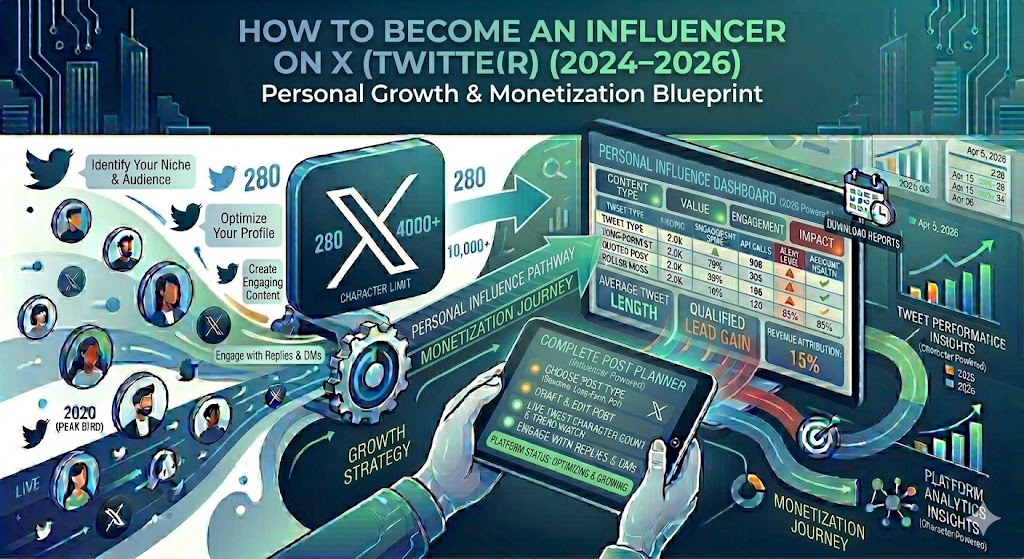
How to Become an Influencer on Twitter (X) in 2024–2026
Key Takeaways
- Twitter (X) remains one of the fastest social media platforms to test ideas, build a personal brand, and attract career opportunities in 2024–2026—without needing expensive equipment or an existing audience.
- Becoming a twitter influencer requires a clear niche, an optimized twitter profile, daily engagement through replies and DMs, and consistent posting over 6–18 months.
- Early growth often comes more from replying thoughtfully to bigger accounts than from your own tweets alone—borrowing audiences is a proven shortcut.
- Serious influencers track analytics weekly, build email lists to reduce algorithm dependency, and eventually monetize through brand deals, digital products, and services.
- Starting from zero twitter followers is completely achievable with focused habits; most creators see meaningful traction after 3–6 months of consistent work.
Twitter—now called X—has evolved significantly since 2022, but its core value proposition for aspiring influencers hasn’t changed: it’s where conversations happen in real time, feedback loops are instant, and text-first content lets anyone compete on ideas rather than production budgets. If you want to become a content creator with genuine influence, this guide walks you through exactly how to do it. This guide is for aspiring content creators, entrepreneurs, and professionals who want to build influence, grow an engaged audience, and unlock new opportunities on Twitter (X).
Success on Twitter (now X) is defined by niche authority and high-quality engagement rather than simple follower counts. The platform’s current AI-driven algorithm prioritizes high-quality content that sparks immediate engagement over large, passive follower lists.
Essential Steps to Becoming a Twitter Influencer
- Build a cohesive personal brand and optimize your profile
- Post high-value content consistently (including threads, videos, and images)
- Engage authentically with your niche community (replying, DMs, Twitter Spaces)
- Use analytics to refine your strategy and posting schedule
- Network with other influencers and participate in trending conversations
- Monetize through brand partnerships, sponsored posts, and digital products
Twitter—now called X—has evolved significantly since 2022, but its core value proposition for aspiring influencers hasn’t changed: it’s where conversations happen in real time, feedback loops are instant, and text-first content lets anyone compete on ideas rather than production budgets. If you want to become a content creator with genuine influence, this guide walks you through exactly how to do it.
Why Twitter (X) Is Still the Best Place to Become an Influencer
Twitter’s relevance in 2024–2026 comes down to three things: real-time conversations, fast feedback, and a strong creator culture that rewards substance over polish.
Unlike YouTube or TikTok, where you need video equipment, editing skills, and often an existing audience to gain traction, X allows newcomers to post stuff and build momentum through text alone. The barrier to entry is remarkably low—you can create great content with nothing more than the twitter app on your phone.
X’s algorithm in 2024 favors time-on-platform signals. This means longer threads, meaningful replies, video content, and posts that keep users engaged outperform low-effort spam. The platform rewards content that sparks genuine conversations, not just quick likes.
The numbers back this up:
Metric | Data |
|---|---|
Global users | 500+ million |
Daily active users | 121 million |
Marketers planning X influencer campaigns (2024) | 25.9% |
Daily active conversations cluster around particular topic areas: business, politics, tech, finance, education, and the creator economy. These niches drive rapid feedback loops and networking opportunities that other social media channels simply can’t match. |
Many large creators, CEOs, tech founders, authors, and investors are highly active on X, making networking uniquely powerful.
When people talk about building influence through social media, they often overlook how much easier X makes it to connect with decision-makers directly. A thoughtful reply to a tech founder’s tweet can lead to a conversation that would never happen on Facebook or Instagram.

Define Your Niche and Influencer Positioning
Vague personal accounts rarely grow on Twitter. Users don’t follow random people—they follow accounts known for specific value. To build a real following, you need to become known for one or two things.
Pick a narrow niche rather than trying to appeal to everyone. Examples include:
- Freelance copywriting tips
- No-code tools for beginners
- Bootstrap SaaS strategies
- Fitness for busy parents
- Logo design for startups
Once you’ve chosen your niche, define a positioning statement: “I help [who] achieve [result] with [topic].” This simple instructions framework guides every tweet you write and helps your target audience understand what following you means.
Before committing, analyze 5–10 successful accounts in your niche and use ethical tactics to find and grow a targeted Twitter audience. Look at:
- Follower count (aim for 10k–100k mid-tier accounts as models)
- Types of posts (tips, case studies, personal stories)
- Tone (contrarian, helpful, entertaining)
- Posting frequency (typically 3–5 posts daily)
This research reveals gaps and opportunities. Maybe nobody’s covering your particular topic for a specific audience segment, or there’s a fresh angle waiting to be explored.
Commit to your niche for at least 90 days before pivoting. This gives both the algorithm and your audience a clear signal about what you offer.
One case study shows a designer growing to 65k+ twitter followers by focusing exclusively on logo design enthusiasts—targeting niche interactions daily and compounding growth over two years.
Set Up and Optimize a High-Converting Twitter Profile
Profile optimization should happen on day one. A poorly optimized twitter page converts a fraction of visitors into followers, wasting every impression you earn.
Choose Your Twitter Handle
Your twitter handle should be:
- Short and memorable
- Related to your niche when possible
- Free of random numbers (avoid @User12345)
If your real name is available, grab it. If building an influencer brand around a topic, something like @SaaSGrowthTips works too.
Profile Photo
Your profile photo is the first visual impression. Use:
- A clear face shot (not a brand logo unless you’re a company)
- Good lighting with an uncluttered background
- The same image across other social media platforms for consistency
Bio Essentials
Your bio needs to accomplish multiple things in limited characters:
- State who you help
- Explain what value you share
- Include credibility markers (e.g., “ex-Google engineer,” “10k+ newsletter subs”)
- Add a personal touch
A proven formula for your bio is: ‘I help [audience] achieve [result] using [method]’. This communicates your value proposition clearly to new visitors.
Example: “Helping SaaS founders scale to $10k MRR | Former Stripe PM | Coffee addict & dog dad”
Header Image
Use your header for extra clarity or social proof. Include:
- A tagline summarizing your value
- Niche keywords
- Logos of publications or companies you’ve been featured in (if relevant)
Pinned Tweet
Pin a value-packed thread, mini-introduction, or case study that shows what following you feels like. This is prime real estate—use it wisely.
High-converting profiles see 20–30% higher follow rates from profile visits compared to unoptimized ones.
Finally, link to a simple landing page or newsletter signup. Building an email list from day one reduces your dependency on algorithm changes.
How to Grow When You Have No Audience
Starting from zero followers in 2024 is common and completely achievable with focused daily habits. Many successful influencers began exactly where you are now.
Find the Right Accounts
Use Twitter’s search and advanced search to find:
- Top creators in your niche (100k+ followers)
- Mid-tier accounts (5k–50k followers) with genuine engagement
- Rising voices who engage actively with their audience
Look for real engagement—replies, conversations, retweets—not just big numbers with silent audiences.
Follow and Enable Notifications
Follow 20–50 relevant accounts initially. Turn on notifications for 5–10 whose audience overlaps with yours. When they tweet, you’ll see it immediately.
The Reply Strategy
The reply strategy is responsible for 10–50% of early growth for many creators. Here’s how it works:
- Be among the first to reply to big accounts’ tweets
- Write thoughtful, specific comments (not “Great post!”)
- Add context, examples, quick tips, or genuine questions
- Never promote yourself directly in replies
This borrows visibility from established accounts while demonstrating your expertise.
Daily Routine
Set aside 30–45 minutes daily dedicated to:
- Replying to relevant tweets (15–20 minutes)
- Posting 1–3 original tweets about your niche (10–15 minutes)
- Engaging with replies on your own content (5–10 minutes)
Even when engagement is low initially, this trains both your posting skills and the algorithm.
Capture Ideas Constantly
Save ideas via bookmarks, notes apps, or Notion throughout the day. This prevents “blank screen” syndrome when it’s time to post. Industry news, conversations you overhear, questions from your real life—everything is potential content.

Creating Engaging Posts and Threads on Twitter
Content quality and clarity matter more than posting content 20 times a day. Strategic content beats high-volume spam every time. Reusable tweet formats that transform your ideas into posts can keep your output consistent without burning out. Visual content is especially important—developing graphic design skills can help you create eye-catching posts that stand out and reinforce your personal brand.
Threads:
Threads allow you to tell a story or share insights in a series of connected tweets. Threads generate significantly higher engagement and dwell time compared to single tweets, making them a powerful format for sharing in-depth content.
Visual Content:
Use images, GIFs, and videos to make your tweets more engaging. Videos on Twitter are 6 times more likely to be retweeted than tweets with photos, and tweets with images receive 94% more total views than those without images. Strong visuals not only capture attention but also help your content perform better in the algorithm.
Simple Tweet Structure
Every tweet should follow this basic structure:
- Strong hook in the first line (stops the scroll)
- 1–3 clear value points
- Call-to-action (question, prompt to reply, or invitation to share)
Example: “Most new creators fail because they skip this one step. They try to speak to everyone instead of someone specific. Pick ONE person. Write for them. Watch engagement climb. What’s the hardest part about finding your niche?”
Content Mix for the Week
Vary your content types to maintain interest:
- How-to tips: “3 ways to write better hooks”
- Short case studies: “How I grew from 0 to 5k in 90 days”
- Personal lessons: “What failing taught me about X”
- Contrarian takes: “Unpopular opinion: threads are overrated”
- Curated links: “This blog post changed how I think about Y”
Writing Threads
Threads drive deeper loyalty and follower growth—often 2–5x impressions compared to single tweets, and mastering Twitter threads as a social media phenomenon helps you share complex ideas more effectively. Structure them like this:
- Start with a bold promise or intriguing question
- Use short lines (1–2 sentences per tweet)
- Break content into narrative or bullet-style formats
- Include visual content: images, carousels, or short videos
- End with a summary and CTA
Thread templates that perform well:
- “I tried X for 30 days—here’s what happened”
- “7 mistakes I made so you don’t have to”
- “Before/after transformations”
- Mini-tutorials with step-by-step breakdowns
Engaging CTAs
End posts with CTAs that start conversations:
- “Reply with your biggest challenge in [niche]”
- “What would you add to this list?”
- “Agree or disagree?”
Posts with more characters dedicated to questions often generate the most engagement.
Build Daily Habits: Posting, Engaging, and Networking
Consistency over months—not days—separates casual users from real influencers. Building a twitter influencer presence isn’t a full time job, but it does require routine, and a structured Twitter content calendar and tools can make that consistency easier.
Sample Daily Schedule
Time Block | Activity |
|---|---|
10–15 minutes | Writing or scheduling tweets |
15–30 minutes | Replying to others’ content |
5–10 minutes | DMs and relationship building |
Schedule Posts Strategically
Post at least once in the morning and once later in the day to hit multiple time zones. To systematically boost reach, apply proven tips to increase Twitter impressions while you test different times over several weeks using your analytics to find what works for your audience.
Schedule tweets in advance using Twitter’s native scheduler or third-party tools, but save real-time engagement for when you’re actively online. Batch-create and schedule a week’s worth of posts in advance to maintain consistency and maximize engagement. Using a content creation calendar can help you structure your posts and determine how frequently you should post to grow your audience.
Proactive DM Strategy
Don’t wait for people to reach out. Engage proactively:
- Compliment specific posts you genuinely enjoyed
- Ask thoughtful follow-up questions
- Suggest potential collaborations
- Connect people who might benefit from knowing each other
Generosity Compounds
Sharing others’ work, quote-tweeting with thoughtful commentary, and celebrating wins in your niche builds goodwill that returns exponentially. Avoid pure self promotion—the ratio should favor giving over asking.
Mention your handle at offline events, conferences, and meetups. These touchpoints bring highly engaged long term followers who already know and trust you.
Tools and Systems to Scale Your Twitter Presence
Tools don’t replace good content, but they make consistency easier once the basics are in place.
Scheduling Tools
Schedule tweets to batch content creation. Write a week’s worth of tweets in one sitting, then schedule them across the week. This prevents the daily pressure of creating from scratch.
Popular options include:
- Twitter’s native scheduler
- Buffer
- Hypefury
- Typefully
Idea Management
Keep a running list of hooks, ideas, and thread outlines in:
- Notion
- Google Docs
- Apple Notes
- Any simple notes app
Review and pull from this list whenever you need to write. Capture ideas immediately—they disappear fast.
Analytics
Use Twitter’s native analytics and proven hacks to skyrocket your Twitter followers to track and act on:
- Impressions per tweet
- Engagement rate (aim for 2–5%+)
- Follower growth over time
- Top posts by profile visits and link clicks
Other tools and external dashboards can provide deeper insights, but start with native analytics.
Experimentation
Test different formats regularly:
- Polls
- Threads vs. singles
- Live video or live streaming
- Images and carousels
Use data to double down on what generates the most engagement and stay aware of Twitter’s 2024 user growth, platform changes, and engagement strategies. But avoid fully automating engagement—real-time replies and DMs build genuine relationships that bots can’t replicate.

Analyzing Results and Refining Your Strategy
Long-term growth requires regular review of what’s actually working. Without analysis, you’re guessing.
Weekly Review Process
Set aside 15–20 minutes weekly to review:
- Top tweets by profile visits
- Posts with the most replies
- Saves and bookmarks (high-value indicator)
- Link clicks to your website or newsletter
Identify Patterns
Look for recurring themes:
- Topics that consistently perform well
- Hooks that get more clicks
- Formats that draw more replies
- Time slots with higher engagement
Double down on winners. Reduce or eliminate content types that drain energy or attract the wrong audience—even if they get vanity engagement.
90-Day Goals
Set clear quarterly targets:
- Reach 2,000 followers
- Launch first lead magnet
- Secure first sponsored tweet
- Convert 500 email subscribers
Review progress every 30 days and adjust tactics accordingly. How many followers you have matters less than whether those followers engage and act on your content.
Monetizing Your Twitter Influence
Monetization typically comes after establishing clear niche authority and building a responsive audience. For most creators, this happens around 1,000–3,000 engaged followers.
Common Monetization Paths
Method | Description |
|---|---|
Brand partnerships | Sponsored content for relevant companies |
Sponsored tweets | Paid promotion of products/services |
Affiliate marketing | Commission on products you recommend |
Digital products | Ebooks, templates, courses ($9–$49+ range) |
Coaching/consulting | 1:1 or group services in your niche |
Build Independence Early
Create an email list or simple website from the beginning and pair it with strategies to get more views on Twitter so more people see your offers. Twitter reported algorithm changes frequently affect reach—your list is an asset you control regardless of platform shifts.
What Brands Want
When brands evaluate potential partners, they look for:
- Niche relevance to their product
- Engagement rate (3%+ is strong)
- Quality of replies and conversations
- Evidence of audience trust
A small following with high engagement often outperforms large accounts with silent audiences.
Start Small
Begin with low-ticket offers to validate demand:
- $9–$29 ebooks or templates
- $49 mini-workshops
- Free consultations that convert to paid services
This approach lets you test what resonates before investing in complex products.
Be transparent with sponsorships and protect audience trust. Decline brand deals that don’t align with your values—long-term credibility beats short-term cash.
Staying Sane and Sustainable as You Grow
Building influence on Twitter carries burnout risks and comparison traps. Sustainability matters more than speed.
Set Boundaries
- Predefined daily time limits (e.g., 1 hour maximum)
- At least one “off” block per week to disconnect
- Notifications off during focused work or family time
Focus on Controllables
Obsessing over daily follower count drives anxiety. Focus instead on actions you control:
- Number of posts published
- Quality replies written
- DMs sent
- Ideas captured
Revisit Your Why
Periodically ask yourself why you want influence: career change, creative expression, business growth, networking? Reconnecting with purpose prevents aimless grinding.
Expect the Slow Start
Sustainable growth often feels slow for the first 3–6 months. Then it compounds as regular content and relationships stack up. Most overnight successes took years of consistent work before their “break,” which aligns with proven strategies for getting famous on Twitter over 6–18 months.
Frequently Asked Questions
FAQ
How long does it realistically take to become an influencer on Twitter?
Most creators see meaningful traction after 3–6 months of consistent posting and engagement. Strong influence—defined as a few thousand highly engaged followers who act on your recommendations—typically takes 12–18 months. Previous audiences on other platforms, professional expertise, or trending topics coverage can shorten this timeline. The key variable is consistency, not talent.
How many followers do I need to start making money on Twitter?
Some creators earn their first dollars around 1,000–3,000 followers if the niche is focused and engagement is strong. A co founder of a SaaS company, for example, might hire you for consulting with only 500 followers if your content demonstrates clear expertise. Brands care about relevance and engagement rate more than raw follower count. Start with small offers or freelance services before reaching “influencer-size” numbers.
Should I use my real name or a brand name as my handle?
Real-name accounts build long-term credibility, allow flexible niche changes, and make relationship building easier. Brand-style names like “CryptoDevTips” or “MumFitnessCoach” sharpen topic focus and can work well for specific niches. If you’re a big fan of building a multi-topic personal brand over time, use your real name. If you want laser focus on one topic and may eventually sell the account, consider a brand name. Choose based on long-term goals.
Is it better to post threads or single tweets?
Both matter for different reasons. Threads deliver deep value and drive follower growth—often generating 2–5x more impressions than single tweets. Singles keep your feed active and show personality between bigger pieces. Aim for 1–3 quality threads per week plus several shorter tweets daily. Test this mix for 30 days, tracking which format drives more profile visits and follows for your specific niche.
What if my niche feels “saturated” on Twitter?
Saturation usually signals strong demand—people want that content. Uniqueness comes from your angle, voice, experience, and specific audience focus. If “fitness” feels crowded, try “fitness for new dads working remote jobs.” If “marketing” is oversaturated, focus on “email marketing for SaaS founders.” Share personal stories, experiments, and case studies. Even in crowded spaces, authentic experiences and own tips stand out. Trending topics and trending hashtags may bring visibility, but niche depth builds long term followers, especially as Twitter marketing trends in 2025 increasingly reward authentic, community-driven content.

![How to get more followers on Twitter: 11 Easy Ways [Tried & Tested]](https://tweetfull.com/blog/wp-content/uploads/2020/09/How-to-get-more-followers-on-Twitter-11-Easy-Ways-_Tried-Tested-768x316.png)