
When Did Twitter Become X? (Timeline, Dates, and Key Changes)
Key Takeaways
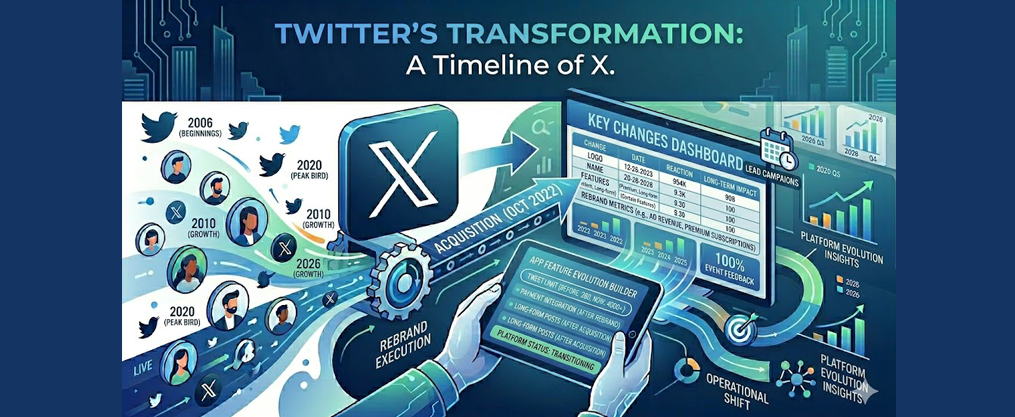
Twitter became X through a multi-step process spanning from April 2023 to May 2024, with the most visible change occurring on July 23-24, 2023 when Elon Musk announced the rebrand and replaced the iconic blue bird logo with a stylized “X.”
- July 23-24, 2023 marks when Elon Musk announced the X rebrand and the bird logo began disappearing from the website and app, replaced by the new “X” branding.
- April 2023 was when Twitter, Inc. was legally merged into X Corp according to court filings, meaning the company called “Twitter” technically ceased to exist months before users saw any visual changes.
- May 2024 saw the final technical piece fall into place when the primary web address switched from twitter.com to x.com, with the old domain redirecting to the new one.
- The transition was deliberately phased: legal merger first (April 2023), then consumer-facing brand and logo change (July 2023), and finally the domain switch (May 2024).
- For most users, the practical answer to “when did Twitter become X” is late July 2023, because that’s when the name and appearance visibly transformed.
Introduction: From Twitter to X
For nearly two decades, Twitter was synonymous with real-time conversation on the internet. The social media platform launched in 2006 with a simple premise: let users post short messages to share thoughts, news, and updates. Over time, it evolved into a powerful infrastructure for modern real-time communication. The iconic bird logo became one of the most recognizable symbols in digital culture, and the act of “tweeting” entered everyday vocabulary worldwide.
Then, in 2022, everything changed. Elon Musk acquired Twitter for $44 billion after a dramatic negotiation process, immediately signaling his intention to reshape the platform. Musk’s vision extended far beyond policy tweaks. He had been fascinated with the letter X since founding X.com in 1999, and he saw an opportunity to transform Twitter into an “everything app” that would combine social networking with payments, commerce, and AI services.
This article answers one specific question that many users still ask: when did Twitter become X? We’ll walk through the key dates, explain the difference between the legal merger and the public rebrand, and clarify why different sources sometimes cite different timelines for this significant shift in social media history. This article is for anyone curious about the timeline and reasons behind Twitter’s transformation into X, including users, marketers, and those interested in social media history.
The Short Answer: Key Dates When Twitter Became X
If you’re looking for a direct answer, here it is: Twitter became X in phases, with the most visible change happening on July 23-24, 2023.
However, the complete picture involves three distinct dates that each represent a different aspect of the transformation. Understanding all three helps explain why you might see varying answers depending on the source.
Key Concepts Defined:
- Rebrand: The rebrand refers to the official change of Twitter’s name, logo, and branding to X, which began on July 23, 2023, when the iconic bird logo was replaced with a stylized X. The rebranding process continued with the domain name changing from twitter.com to x.com on May 17, 2024.
- X: “X” is the new name and brand identity for the platform formerly known as Twitter, representing Elon Musk’s vision for an “everything app” that goes beyond microblogging to include payments, commerce, and AI services.
- Domain Switch: The domain switch refers to the technical change in the platform’s primary web address from twitter.com to x.com, which was completed on May 17, 2024.
Mini-Timeline: When Twitter Became X
- April 2023 (approximately April 10): Court filings revealed that Twitter, Inc. had been merged into X Corp, ending Twitter as a separate legal entity. Most users were unaware of this change.
- July 23-24, 2023: Elon Musk announced the rebrand publicly. The iconic blue bird logo was removed from the website and app within roughly 24 hours, replaced by the stylized white “X” on a black background. Interface text began shifting from “tweet” to “post.”
- May 17, 2024: The primary web address changed from twitter.com to x.com, with the former automatically redirecting to the new domain.
For everyday users, late July 2023 is the answer that matters most. That’s when the twitter brand visibly disappeared and X took its place. The legal transition happened earlier behind the scenes, while the domain change came nearly a year later to complete the technical transition.

Background: How We Got From Twitter to X
Understanding the rebrand requires knowing what Twitter was before Musk’s acquisition. The platform’s journey from startup to global phenomenon set the stage for why the transformation felt so dramatic, and its continued expansion to hundreds of millions of active users underscores how influential Twitter’s growth and platform changes in 2024 have become for businesses and everyday communication.
Twitter’s Origins and Early Growth
Twitter was created in March 2006 by Jack Dorsey, Evan Williams, Biz Stone, and Noah Glass. The project originally went by the name “Twttr,” inspired by Flickr and the five-character length of American SMS short codes. The team had to wait six months after launch before they could purchase the twitter.com domain and adopt the full name.
Growth came rapidly. By 2009, Twitter had won the “Breakout of the Year” Webby Award. In February 2010, users were sending 50 million tweets per day. By June of that year, the platform recorded approximately 65 million tweets daily—about 750 tweets per second. According to Compete.com rankings, Twitter jumped from twenty-second to third among social networking sites by January 2009.
Becoming a Public Company
Twitter went public in November 2013 under the ticker symbol TWTR. The company had grown to more than 100 million users producing 340 million daily tweets by 2012. The social network became integral to news coverage, political discourse, and entertainment industry communication worldwide, even as ongoing debates about content moderation and user safety raised questions about how X could improve engagement and trust through better policies and product updates.
The platform weathered various challenges through the 2010s: content moderation debates, trending topics manipulation concerns, and competition from other platforms. Still, the bird logo remained a fixture of internet culture.
Musk’s Entry and Acquisition
Elon Musk’s involvement began publicly in early 2022 when he started acquiring Twitter shares. His acquisition deal valued the company at $44 billion at his original proposed price of $54.20 per share. The process included drama—Musk initially attempted to back out citing concerns about bot accounts, but ultimately musk completed his purchase of Twitter in October 2022.
Musk acquired Twitter with stated goals around promoting free speech on the platform. Among his first actions were laying off approximately half the company’s workforce and changing the verification system to allow users to purchase the blue check mark for $8 per month. These early moves signaled that bigger changes were coming and marked the beginning of what many observers call the “Twitter 2.0” Musk era of product and policy overhauls.
Legal Transition: When Twitter, Inc. Became X Corp.
Before users saw any visual changes, important structural shifts were happening behind the scenes. The legal transition from Twitter to X occurred months before the famous logo swap.
Here’s what happened with the corporate structure:
- March 2023: Elon Musk registered three separate Nevada companies: X Corp., X Holdings Corp. (which became the new parent company of X Corp.), and X.AI Corp. (commonly known as xAI). These entities were specifically created to facilitate Twitter’s transformation.
- April 2023: The formal merger between Twitter and X Corp. took place. According to a court filing in California, Twitter ceased to exist as a company following this merger. Twitter, Inc. was absorbed as a wholly owned subsidiary that then dissolved.
- Delisting: When Twitter, Inc. ceased to exist as a separate entity, the ticker symbol TWTR was delisted from major stock exchanges. X became a private company controlled by Musk.
- Invisible to Users: During this entire period, users still saw the familiar twitter name and bird logo across all interfaces. There was minimal public communication about the structural change.
The legal merger is significant because it means that on paper, Twitter had already become part of X several months before any visible changes appeared. When the rebrand eventually went public in July 2023, the underlying corporate transition was already complete.
Most everyday users were completely unaware that Twitter, Inc. had technically ended. The company deliberately staged the rebrand—handling the corporate restructuring first, then executing the public-facing brand transition later.
Branding Shift: July 2023 Rebrand to “X”
The moment most users remember as “when Twitter became X” came on July 23-24, 2023. This was when the transformation became impossible to ignore.
Musk’s Announcement
On July 23, 2023, Elon Musk posted publicly that he would “bid adieu to the twitter brand” and that “gradually, all the birds” would be removed. This message created immediate attention and signaled that a major change was imminent. Within roughly 24 hours, the blue bird was gone.
The Logo Switch
The iconic bird logo—which had been Twitter’s visual identity for nearly 17 years—was removed from the website and mobile apps. In its place appeared a stylized white “X” on a black background. The speed of execution suggests a coordinated, well-planned rollout rather than a hesitant transition.

Key changes during the July 2023 rebrand:
- The blue bird logo disappeared from the website header and app icons
- A new logo featuring a stylized “X” replaced the bird across all platforms
- The company’s headquarters in San Francisco saw signage alterations to display a prominent illuminated “X” where the bird had been
- App listings in Apple and Google app stores were updated to display “X” rather than “Twitter”
- Interface terminology began shifting from “tweet” to “post,” though this rollout was gradual
Gradual Interface Updates
While the logo changed quickly, the complete terminology shift took longer. References to “tweets” didn’t disappear overnight across every platform element. The technical implementation involved updating various systems and interfaces progressively, which is typical for platforms handling billions of interactions daily.
For most users, July 23-24, 2023 is the practical answer to “when did Twitter become X.” This is when the name and look visibly changed, even though the legal structure had shifted earlier and the domain would change later.
Domain and App Transition: From Twitter.com to X.com
Even after the July 2023 visual rebrand, one important piece of the old identity remained: the web address. Throughout late 2023 and early 2024, the primary URL was still twitter.com despite all the “X” branding.
Musk’s History With X.com
Understanding why the domain eventually changed requires knowing Musk’s personal connection to X.com:
- In 1999, Musk co-founded X.com as an online financial services company
- X.com later merged with Confinity to become PayPal
- After PayPal was sold to eBay in 2002, the x.com domain eventually became available
- Musk repurchased the x.com domain in 2017, demonstrating his long-standing attachment to the brand
This history explains why acquiring x.com for the formerly twitter platform was always part of Musk’s vision.
The May 2024 Domain Switch
Here’s the timeline for the final technical transition:
- Throughout late 2023 and early 2024, twitter.com remained the primary web address even with X branding
- In May 2024 (specifically May 17, 2024), the platform updated its web routing so that x.com became the primary address
- Users who typed twitter.com began being automatically redirected to x.com
- Existing links and bookmarks to twitter.com continued to function due to the automatic redirect
- App store listings and icons were further updated to emphasize “X” rather than “Twitter”
By May 2024, the rebrand was fully comprehensive: the product name was X, the company structure was based on x corp, the logo was the stylized X, and now the URL was x.com. This marked the completion of a three-phase rebrand spanning from April 2023 through May 2024.

Why Did Elon Musk Turn Twitter into X?
The rebrand wasn’t a sudden whim. Musk’s motivations trace back decades and connect to his broader ambitions for technology and business.
Personal Fascination With “X”
Musk has been fascinated with the letter X since at least 1999 when he founded X.com as an online banking startup. This decades-long attachment appears throughout his ventures:
- X.com (1999 online bank, later became PayPal)
- SpaceX (space exploration company)
- X Holdings (corporate entities used for the Twitter acquisition)
- xAI (his artificial intelligence company)
The rebrand represents the culmination of a long-held ambition to use the X brand for a major consumer platform.
The “Everything App” Vision
Musk explicitly stated that “the twitter name made sense when it was just 140 character messages going back and forth – like birds tweeting – but now you can post almost anything, including several hours of video.”
His musk’s vision extends to building an “everything app” modeled on Asian super apps like WeChat:
- Messaging and social networking combined in one platform
- Payment services allowing users to “conduct your entire financial world” within the app
- E commerce features including tipping, ticketing, and shopping
- AI integration through xAI’s Grok chatbot
- Content creation tools supporting long-form posts and extended video
The twitter brand, with its association of short posts and birds tweeting, couldn’t credibly enter domains like financial services. The X identity opened new strategic possibilities.
Breaking From the Past
Since Musk acquired Twitter in October 2022, the platform had accumulated controversy: massive staff reductions, content moderation changes, reinstatement of banned accounts, and the paid verification shift. By rebranding to X, Musk could symbolically mark a new era and distance the platform from accumulated negative associations.
The decision was polarizing. Some observers viewed it as visionary—a bold move to expand beyond Twitter’s constraints. Others saw it as a strategic error—squandering one of the most globally recognized brand names in internet history for something less established.
How X Differs From the Old Twitter
The name change came alongside fundamental shifts in how the platform operates. Understanding these differences is crucial for anyone trying to publish effectively, since creating successful updates now means mastering best practices for engaging, high-impact X (Twitter) posts. Here’s how X differs from the Twitter that users knew:
Content and Format Changes
Feature | Old Twitter | X |
|---|---|---|
Post length | Originally 140 characters, later 280 | Much longer posts supported |
Video | Short clips, time-limited | Several hours of video possible |
Content types | Primarily short posts and links | Long-form texts, extended media |
Terminology | “Tweets” | “Posts” |
Verification System Transformation
The classic twitter user verification worked through reputation:
- Blue check marks were awarded by the platform to notable public figures
- Verification was free but required meeting significance criteria
- Journalists, celebrities, and organizations received checks through manual review
Under X, verification became subscription-based:
- Blue checks available for $8 per month through paid subscriptions
- Anyone with a subscription can obtain verification
- The change democratized verification but undermined its credibility as a marker of notability
Content Moderation Shifts
Musk’s takeover brought significant changes to how the platform handles content:
- Large staff reductions affected content moderation teams
- Previously banned accounts were reinstated
- Reduced algorithmic feed restrictions in favor of Musk’s “digital town square” philosophy
- Changed policies around what constitutes acceptable content
The platform has faced criticism for enabling increased spread of disinformation since these changes, though supporters frame it as expanding free speech protections.
New Features and Directions
X introduced features that would have seemed out of place under the Twitter brand:
- Account monetization options for creators
- Integration with Grok AI assistant
- Job search functionality
- Audio-video calls
- Experiments with ticketing and commerce
- Long-form content publishing
The user engagement model shifted from pure advertising revenue toward diversified income including creator subscriptions and premium features, reshaping how brands approach campaigns and fueling new Twitter marketing trends that define the platform’s advertising and engagement strategies in 2025.

User and Market Reaction to the Rebrand
The transformation from Twitter to X generated strong reactions from users, advertisers, and industry observers alike.
User Response
The loss of the twitter name and iconic bird logo triggered emotional responses from long-time users who viewed the rebrand as the end of an internet era. Many people had spent years building audiences, developing communication habits, and creating communities around the Twitter identity, often following deliberate frameworks for becoming popular on Twitter through consistent, relationship-driven engagement.
Media coverage frequently framed the change as “the end of Twitter” rather than simply a name change. The bird logo had been in continuous use since 2006, making it one of the most recognized symbols in digital culture globally, especially for creators like authors who had learned how to leverage Twitter as writers to build readership and promote their work.
Migration to Competitors
User base shifts occurred following both musk’s acquisition in October 2022 and accelerated during the July 2023 rebrand:
- Threads: Meta’s Twitter competitor launched in July 2023, directly during the rebrand period, explicitly positioning itself as an alternative
- Bluesky: Created by former Twitter CEO Jack Dorsey, gained users seeking a Twitter-like experience
- Mastodon: The decentralized social network saw increased adoption among users unhappy with Musk’s changes
While migration occurred, X retained a substantial global user base and remained central to news coverage and public conversation, continuing to reward users who apply structured approaches to getting famous on Twitter by building sustained visibility in their niches.
Advertiser Concerns
Major advertisers reduced or paused spending on X amid concerns about:
- Brand safety in the new content moderation environment
- Policy instability and uncertain platform direction
- Changes in audience composition and platform culture
- Personal controversies surrounding Musk himself
The combination of staff reductions, moderation changes, and rebrand uncertainty created a challenging environment. However, X’s importance to media and political discourse meant complete advertiser abandonment didn’t occur—spending was reduced rather than eliminated.
Industry Analysis
Brand consultants and business analysts questioned whether discarding the globally recognized Twitter brand made strategic sense. The rationale for moving away from an established name toward a less specific brand like “X” struck many observers as counterintuitive.
Some analysis suggested that even if Musk wanted to pivot toward the “everything app” model, maintaining the Twitter brand while adding new functionality might have been preferable. However, Musk’s personal attachment to X and his vision of complete platform reimagining apparently outweighed these concerns.
Despite criticism, X retained significant global influence. The platform remained central to real-time information sharing, and many prominent users—journalists, politicians, public figures—maintained active presence even while exploring competing platforms.

FAQ
Did Twitter legally stop existing before the logo changed to X?
Yes, Twitter, Inc. was merged into X Corp by April 2023 according to court filings, even though the public still saw the Twitter brand until July 2023. The company structure changed first through a legal merger that went largely unnoticed by everyday users.
This means there was approximately a three-month gap between when Twitter ceased to exist as a separate legal entity and when consumers saw the famous logo swap. Musk announced the visible rebrand in late July, but the corporate restructuring had already been completed. For practical purposes, people still called it Twitter and saw the bird logo until the July rebrand, even though the company behind it was technically already X Corp.
Is it still correct to say “Twitter” and “tweet,” or should I say “X” and “post”?
The official brand now calls the service “X” and refers to updates as “posts.” However, many users, media outlets like CBS News, and even some interface elements informally still use “Twitter” and “tweet.” The terms remain widely understood.
For writers and communicators, context matters. Using “X (formerly known as Twitter)” provides clarity for audiences who may not have followed the rebrand closely. In casual conversation, both terms remain acceptable since the platform formerly twitter operated under that name for 17 years. Professional contexts increasingly use “X,” while informal usage often mixes terminology based on habit and audience familiarity.
When did the Twitter app icon and store listing actually change to X?
The app icon and branding were updated shortly after the July 23-24, 2023 rebrand announcement, with app store listings shifting from “Twitter” to “X” over the following days. The exact day varied slightly by platform and region as updates rolled out through Apple’s App Store and Google Play.
Users who had automatic updates enabled saw the new logo appear on their home screens within days of musk announced the change. Those with manual updates experienced the transition when they next updated the standalone app. The visual change was unmistakable—the familiar blue bird was replaced by a white X on a black background.
Did features change immediately when Twitter became X?
While the name and logo changed quickly, most features evolved gradually through 2023-2024. The new features weren’t all deployed simultaneously with the rebrand. Expanded post lengths, subscription options, AI integrations with Grok, and other additions were rolled out over time.
Many core functions—following accounts, posting updates, direct messaging, browsing trending topics, and viewing search results—remained recognizable from the Twitter era even after the rebrand. The platform’s fundamental social network architecture stayed intact while new capabilities were layered on progressively. Users experienced continuity in basic functionality even as the surrounding brand identity transformed.
Will Twitter ever come back, or is X permanent?
There is no official plan to restore the Twitter brand. Musk has repeatedly framed X as the platform’s future identity and continues investing in the “everything app” concept. The twitter rebrands represents a deliberate strategic pivot, not a temporary experiment.
While users can still reach the site via twitter.com redirects, the long-term strategy centers entirely on the X name, logo, and expanded platform vision. The eight years of brand equity built under the Twitter name have been consciously set aside in favor of musk’s vision for a comprehensive digital platform. Unless there’s a change in ownership or dramatic strategic reversal, X appears to be the permanent identity going forward.



![Free Twitter Accounts With Passwords [2026 Guide]](https://tweetfull.com/blog/wp-content/uploads/2026/04/Free-768x316.png)